



Point of this article..
- ChatGPT now handles around 12% of total Google search volume, according to data from Ahrefs.
- Google still remains the largest source of website traffic, sending approximately 190 times more clicks compared to ChatGPT.
- Traditional SEO is still important, but it is now evolving into EEAT → AEO → GEO to adapt to the AI era.
The discussion around ChatGPT search volume vs Google search traffic in 2026 is no longer theoretical. According to recent data analysis, ChatGPT now handles search-like queries equivalent to around 12% of Google’s total search volume. This shift is forcing publishers to rethink traffic strategy, SEO foundations, and AI visibility.
A few years ago, almost everyone started their information search on Google. Looking for recipes, how to fix a car, SEO tips, or movie recommendations everything began with Google.
But now, behavior is shifting. Many people are starting to look for answers directly through AI like ChatGPT, without opening multiple website links.
According to analysis from Ahrefs, a well-known SEO research company that analyzes search engine data, ChatGPT now handles search-like queries equivalent to around 12% of Google’s total search volume. In other words, AI has become a place where people search for answers, and its contribution is significant on a global scale.
What Does ChatGPT Search Volume vs Google Search Traffic in 2026?
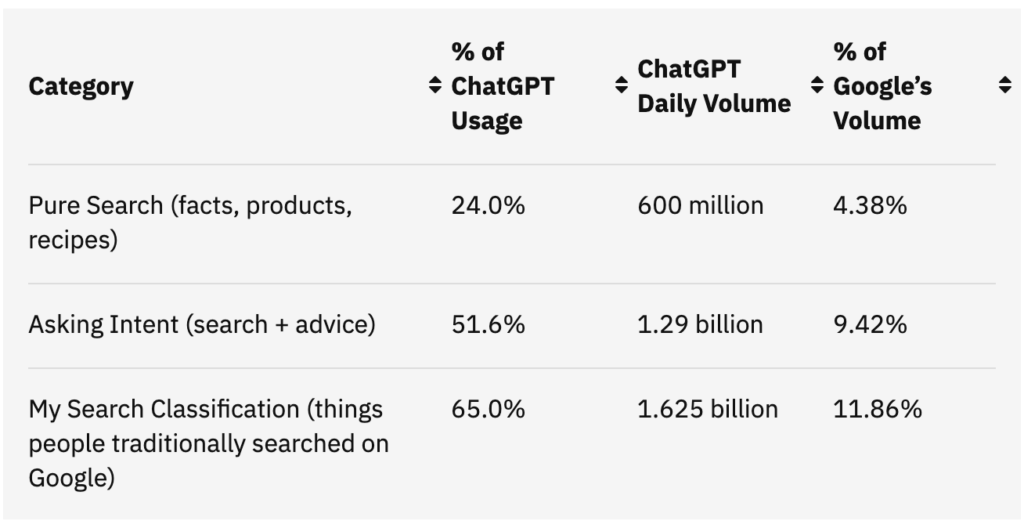
When analyzing ChatGPT search volume vs Google search traffic in 2026, one key insight becomes clear: volume does not equal referral traffic. Google remains the dominant traffic engine, while AI platforms increasingly function as answer engines.
Based on Ahrefs’ analysis, ChatGPT processes billions of prompts every day. When those prompts are categorized as search-type queries (information, comparisons, general questions), the volume equals roughly 12% of Google’s total searches.
Analogy:
Imagine that out of 100 people searching for information online…
Around 12 people now directly ask ChatGPT instead of typing into Google.
This shows two major things:
- People are becoming more comfortable using AI to get instant answers.
- Information search habits are no longer limited to traditional search engines.
Why Does Google Still Send 190 Times More Traffic to Websites?
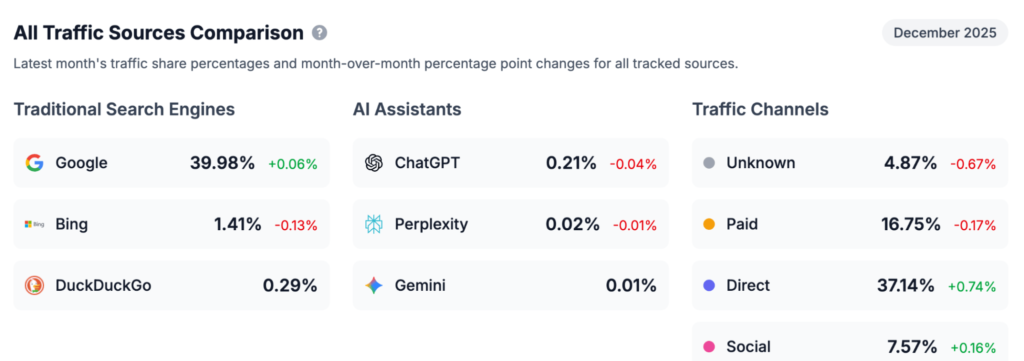
Even though AI search volume on ChatGPT is increasing, Google still sends around 190 times more traffic to websites compared to ChatGPT.
Why? Because the way the two platforms work is different.
How Google Sends Traffic:
- Google displays a list of links.
- Users click.
- Websites receive visits.
How ChatGPT Provides Answers:
- ChatGPT gives direct answers within AI.
- Users often don’t need to click a website.
- Websites may not receive traffic from that answer.
The simple difference:
- Google gives recommendations that direct users to websites → traffic.
- ChatGPT gives direct answers → fewer website clicks.
That’s why even though ChatGPT has a large search volume, website traffic still mainly comes from Google.
Will ChatGPT Replace Google in the Future?
Not entirely. ChatGPT does not remove Google from the search landscape.
Google still dominates in:
- Product searches
- Local searches
- Transactions and e-commerce
- Information that requires verified sources and links
Meanwhile, ChatGPT is more commonly used for:
- Brief explanations
- Summaries
- Content ideas
- Quick suggestions
- Comparisons
The core idea:
- Google is still strong as a click (traffic) source.
- ChatGPT is growing as an answer (visibility) source.
They are not enemies, they complement how people search for information in the digital era.
SEO Strategy in the Era of Generative AI and Answer Engines
Many people assume that because AI like ChatGPT exists, traditional SEO is no longer important.
That is incorrect. In fact, the opposite is true.
To be “pulled,” read, and referenced by AI, a website still needs a strong SEO foundation, especially the principle of EEAT (Experience, Expertise, Authoritativeness, Trustworthiness).
AI does not create information from nothing. AI takes, studies, and restructures information from sources that are already considered credible and relevant on the internet.
Sources usually taken include:
- Well-structured websites
- Sites with topical authority
- Consistent niche coverage
- Strong trust signals
- Natural recognition or backlinks
All of these are results of proper SEO.
In the past, optimizing SEO only for Google ranking was enough. Not anymore.
Modern SEO has evolved into two important terms:
1. AEO (Answer Engine Optimization)
This is the next step after EEAT. If EEAT evaluates quality, AEO evaluates whether content is worthy of being a direct AI answer.
AI prefers answers that are:
- Short and clear
- Easy to understand
- Key points placed early
- Not overly complicated
This increases the chance of AI including your content as a reference in its answers.
2. GEO (Generative Engine Optimization)
Beyond AEO, content should not only be worthy of becoming an answer but also predicted to appear automatically in generative AI results.
For example:
AI states: “Based on trusted sources, X is the answer.” This means your content is relevant enough to appear in AI responses even without user clicks.
What Is the Difference Between SEO, AEO, and GEO in Modern Digital Strategy?
Now we have these terms:
- SEO (Search Engine Optimization)
- AEO (Answer Engine Optimization)
- GEO (Generative Engine Optimization)
It’s important to understand:
AEO and GEO do not replace SEO. They are extensions of SEO.
The strategic structure looks like this:
- SEO → so websites are easily found and crawled.
- EEAT → so content is trusted.
- AEO → so content can become direct AI answers.
- GEO → so brands frequently appear in generative AI results.
Without SEO, AI struggles to find your website. Without EEAT, AI struggles to trust it. Without a clear answer structure, AI struggles to quote it.
How Can a Website Appear in ChatGPT or AI Results?
There is no guaranteed formula, but several factors increase the chances:
- Content answers questions directly
- Question-based headings
- Simple topic explanations
- Consistency in a specific niche
- Strong topical authority
In short, AI prefers content that is:
Clear. Structured. Easy for humans to understand.
Not content that only chases keywords.
What Is the Impact on Publishers and Online Media?
For publishers, this is not a danger signal but an adaptation signal.
Google remains important for traffic. AI becomes important for visibility and brand authority.
This means current strategy should include:
- Short-term traffic optimization
- Long-term authority building
- Niche consistency
- AI-friendly content structure
Publishers who combine classic SEO with AEO and GEO approaches will be better prepared for change.
If you need a more structured approach and want to avoid trial and error, collaboration with strategies developed by ProPS can help create a more stable and measurable roadmap.
Because in the AI era, speed of adaptation is an advantage.
If previously your focus was only ranking on Google, now you need to think about:
Visibility in AI also matters, as many people now search for answers directly from AI without clicking websites.
This means website traffic patterns may change, but branding and awareness opportunities are expanding.
What used to focus only on “clicks” now also needs to focus on “being included in AI answers.”
Simple Analogy to Make It Easier to Understand
- Google: A Big Billboard at a Road Intersection
→ Many people see it and visit your store = traffic - ChatGPT: A TV Presenter
→ Gives direct recommendations — people remember your business because it was mentioned — but they don’t immediately visit
Both have different strengths:
- Google for direct traffic
- ChatGPT for brand recall / awareness
Conclusion
Based on data from Ahrefs, ChatGPT now has search volume equivalent to around 12% of Google. However, Google still sends significantly more traffic to websites. This means SEO and EEAT remain the primary foundation for websites to be crawled, trusted, and even pulled into generative AI results.
For publishers, this is not about choosing between Google or AI, but optimizing both through SEO, AEO, and GEO strategies. In addition to maintaining stable traffic, monetization opportunities in the AI era must also be considered. The ProPS team is ready to help manage and optimize your website’s potential sustainably.
Ultimately, understanding ChatGPT search volume vs Google search traffic in 2026 helps publishers balance short-term traffic from Google with long-term AI visibility and monetization resilience.
FAQ
- Will ChatGPT replace Google?
No. AI like ChatGPT does not replace Google, but it influences how people search for information. - Why does Google still send more website traffic?
Because Google provides clickable links, while AI provides direct answers. - If ChatGPT doesn’t send much traffic, is it still important?
Yes. AI visibility can build brand awareness and authority, even if it doesn’t always generate direct clicks. - What is the difference between AEO and GEO?
AEO focuses on optimizing content to become AI answers. GEO focuses on making content appear automatically in generative AI results. - What is EEAT?
EEAT is a content quality standard that evaluates experience, expertise, authority, and trustworthiness.