



Point of this article..
- Ad impression is a basic metric that shows how many times an ad appears on a user’s screen.
- Impression is different from reach, each has its own important role.
- Beginner publishers can start from zero and grow with the right system.
What is ad impression and why are publishers making money from it while you’re not? Discover how ad impression, CPM, and reach secretly drive digital revenue.
When you visit a website or scroll through social media, have you ever thought, why does this ad appear here? And more importantly, why is every ad counted as something valuable?
The answer is Ad Impression. This metric is one of the main foundations of digital advertising. Unfortunately, for many beginners, this term still sounds technical and confusing.
Many people already have a website, Instagram account, LinkedIn profile, or YouTube channel, but they still don’t know how to convert traffic and content into real income.
That’s why we help publishers start from zero to understand monetization, organize ads, and maximize the value of ad impressions without the technical headache.
What Is Ad Impression?
Ad impression is the number of times an ad is displayed to users on their screen. Every time an ad appears on the screen, it is counted as 1 impression, regardless of whether the user clicks on it or not.
Impression only shows a “view”, not a click, not an interaction but an opportunity for advertisers to be seen.
Analogy:
Imagine you own a shop and there is a billboard in front of it. Every time someone walks by and looks at that billboard, you record “1 person saw the ad.” That is an Impression.
How Does Ad Impression Work?
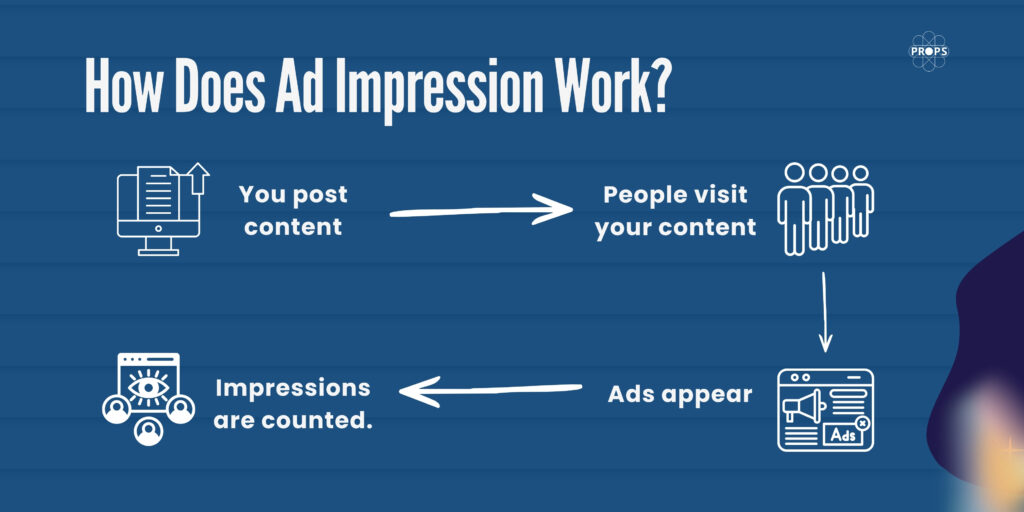
Ad impression works as follows:
- The user opens a platform: for example a website, Instagram feed, LinkedIn, or YouTube.
- The system loads relevant ads based on the platform’s algorithm.
- The ad appears on the screen, even if the user doesn’t click or interact.
- The platform records an impression for each time the ad is displayed.
Where Do Ad Impressions Occur on a Website?
On a website, ad impressions happen whenever an advertisement successfully loads and appears on a visitor’s screen.
It does not require a click.
It does not require interaction.
If the ad is displayed that counts as one impression.
Common Places Where Ads Appear on a Website
Websites usually have multiple ad placements, such as:
- Header – at the top of the page
- Sidebar – on the left or right side
- Within the article (in-content ads) – placed between paragraphs
- Sticky banner – stays visible while the user scrolls
- Footer – at the bottom of the page
Each placement is called an ad slot.
Why are Impressions Important?
Several things you should understand:
- Impressions show how often your content appears to an audience. This is important for brand awareness and click potential.
- While not an engagement metric, impressions affect advertiser campaign budget decisions, especially those using CPM.
- A high number of impressions on a piece of content can mean the audience is waiting for more of your content if you remain consistent.
After you understand that an ad impression is every time an ad appears on the screen, a most important question arises as a publisher:
“If my ads have already appeared thousands of times, then how do I turn those views into money?”
This is where the concept of CPM comes into play.
What is CPM?
CPM (Cost Per Mille) is a metric to calculate the total advertising cost or ad revenue for every 1,000 ad impressions.
Main CPM Formula:
CPM = (Total Ad Cost ÷ Total Impressions) × 1,000
Calculation Example
Suppose you are running an ad campaign on a website with the following details:
- Total Cost: Rp500.000
- Impressions: 100.000 times
The Calculation:
- Divide the total cost by the number of impressions: Rp500.000 ÷ 100.000 = Rp5 (this is the cost per 1 impression).
- Multiply the result by 1,000: Rp5 × 1.000 = Rp5.000.
- So, your CPM value is Rp5.000.
Why is CPM Used?
- Brand Awareness: Very effective for increasing brand awareness because it focuses on how many people see the ad.
- Cost Efficiency: Makes it easier for advertisers to compare efficiency across platforms (e.g., comparing YouTube Ads with Amazon Advertising).
- Measurable Budget: Helps estimate audience reach based on the available budget.
Why are Impressions Important?
Several things you should understand:
- Impressions show how often your content appears to an audience. This is important for brand awareness and click potential.
- Even though it is not an engagement metric, impressions influence advertiser campaign budget decisions, especially for those using CPM.
- A high number of impressions on a piece of content can mean the audience is waiting for more of your content if you remain consistent.
After understanding that not all impressions hold the same value, another common follow-up question arises:
“If impressions are about how many times an ad appears, how do we know how many people actually saw our ad?”
This is where the concept of reach becomes very important.
What is Reach?
A metric used to count the number of “unique people” who view content or ads within a specific period.
In short:
- Impression = how many times the ad appeared.
- Reach = how many different people saw that ad.
Simple Analogy:
Imagine you are handing out flyers.
- You hand out 100 flyers → that is the impression.
- But it turns out you only gave them to 40 people, because some people received 2–3 flyers → that is the reach.
So, Reach only counts one person once, even if they see the content multiple times.
How Does Reach Work?
Reach is calculated based on unique users, usually identified by:
- IP Address
- Sign-up or Login account
- Device ID
Example:
One person opens your website:
- Morning → sees the ad (1 impression)
- Afternoon → opens it again (2 impressions)
- Night → opens it again (3 impressions)
Total = 3 impressions, 1 reach
Why are Reach Figures Often “Misleading”?
It is important to remember that Reach is almost never 100% accurate due to several obstacles:
- Shared Devices: One iPad used by a whole family will still be counted as 1 unique user (Reach = 1), even though 3 people actually saw it.
- Multiple Browsers: If I see your ad in Chrome and then see it again in Safari (without being logged in), I will be counted as 2 unique users (Reach = 2).
- Privacy Settings: Users using a VPN or blocking trackers will not be accurately counted in Reach metrics.
Comparison: Impression vs. Reach
| Aspect | Impression | Reach |
| Focus | Number of ad views | Number of unique people |
| Nature | Can be repetitive for the same person | One person is counted once |
| Main Goal | Volume & monetization | Audience reach |
| Best For | Revenue optimization | Branding & awareness |
Which One is More Important?
The answer: it depends on your goal.
- If your goal is making money from ads → focus on impression & CPM.
- However, if your goal is brand awareness & audience growth → focus on reach.
Professional publishers always balance the two.
Strategies to Increase Ad Impressions
- Quality & Targeted Content: Engaging content quality makes users return more often, leading to much higher ad display opportunities.
- SEO and Optimization: Increasing organic website traffic creates more opportunities for ads to appear to new users.
- Smart Ad Placement: Pay attention to ad positions; ads that are easily seen tend to be recorded as viewable impressions.
- Social Media Consistency: Posting regularly on IG, LinkedIn, and YouTube helps algorithms show your content more frequently.
For many publishers, these optimizations are often handled by monetization partners like ProPS, who are experts in arranging ad placements, increasing viewability, and maximizing CPM.
Conclusion
Ad impressions are more than just numbers; an ad impression is a real monetization opportunity. By understanding how impressions work, how to calculate them (via CPM), and how to maximize them.
If you want to be guided from zero to optimal monetization, we are ready to help you manage strategies, placements, and ad performance without technical hassle.
FAQ
- Is an impression the same as a click?
No. An impression is an ad display, while a click is a direct interaction. - Is CPM always stable?
No. It is influenced by season, niche, country, and traffic quality. - Does reach affect impressions?
Certainly, yes, because a large reach has the potential for large impressions. However, a small reach with high frequency can also generate many impressions. - Is having more ads on a page always better?
No. Because too many ads can result in lower CTR and CPM, and even drive users away. - Can ProPS help optimize ad impressions?
ProPS can help publishers from the setup stage, impression optimization, CPM, and CTR, to long-term monetization.