



Point of this article..
- A surge in bot traffic from China is occurring globally and targeting various types of websites.
- Traffic appears high in Google Analytics but generates almost no real interaction.
- The impact can affect data accuracy, ad monetization, server performance, and business decision-making.
Website traffic suddenly spikes dramatically, but there are no clicks, no conversions, and no increase in revenue? It could be that your website is experiencing a surge of unexplained bot traffic that has recently been widely reported around the world.
Many website owners have reported this bot traffic phenomenon. This mysterious spike in traffic is mostly reported to originate from China and partially from Singapore or even Iran, but it does not show behavior similar to human users.
Many website owners initially assumed this was growth from a new market. However, after deeper analysis, it turned out there was no business impact at all.
What Is Bot Traffic?
Bot traffic is visits to a website performed by automated programs (bots), not humans.
Bots have actually been part of the internet for a long time. Search engines like Google use bots to index websites so they can appear in search results.
However, in the case of this wave of unexplained bot traffic, the pattern is very different:
- Extremely large volume
- Appears suddenly
- No interaction
- Occurs simultaneously in many countries
Several reports show that many website owners worldwide suddenly experienced extremely high traffic spikes from IP addresses that appear to originate from China (especially the city of Lanzhou), even though these visitors are not regular human users.
What Is Actually Happening?
At the beginning of 2026, reports from various international sources show a very consistent pattern. Thousands of website owners in different countries suddenly saw unusual spikes in traffic.
Most of this traffic comes from IP addresses detected from China, particularly from the city of Lanzhou, and partially from Singapore. However, after deeper analysis, these visits were not from normal human users.
This phenomenon is now widely known as the wave of unexplained bot traffic or a mysterious surge of bot traffic.
Here are the most commonly reported patterns:
- Traffic spikes dramatically within a short time without any marketing campaign
- Traffic sources can appear from anywhere but are dominated by China (especially Lanzhou)
- Recorded as “Direct Traffic” in analytics (without referral from other websites)
- Session duration is extremely short (0–a few seconds)
- Bounce rate is very high
- No clicks, no significant scrolling, and no conversions
- No events triggered such as add-to-cart or purchases
In dashboards such as Google Analytics, the graphs look “good” because traffic increases. However, when user behavior is examined, all indicators show anomalies.
This clearly indicates that the behavior is not from real humans. It is a large-scale automated bot activity.
Why Is It Called “Unexplained”?
It is called unexplained because:
- There is no official claim from major companies
- There is no announcement of a global cyberattack
- No mass malware has been detected
- No clear monetization pattern is visible
These bots are not attempting to log in, performing brute force attacks, or damaging websites. They simply enter, read quickly, and leave.
What Are the Main Reasons Behind This Bot Traffic Surge?
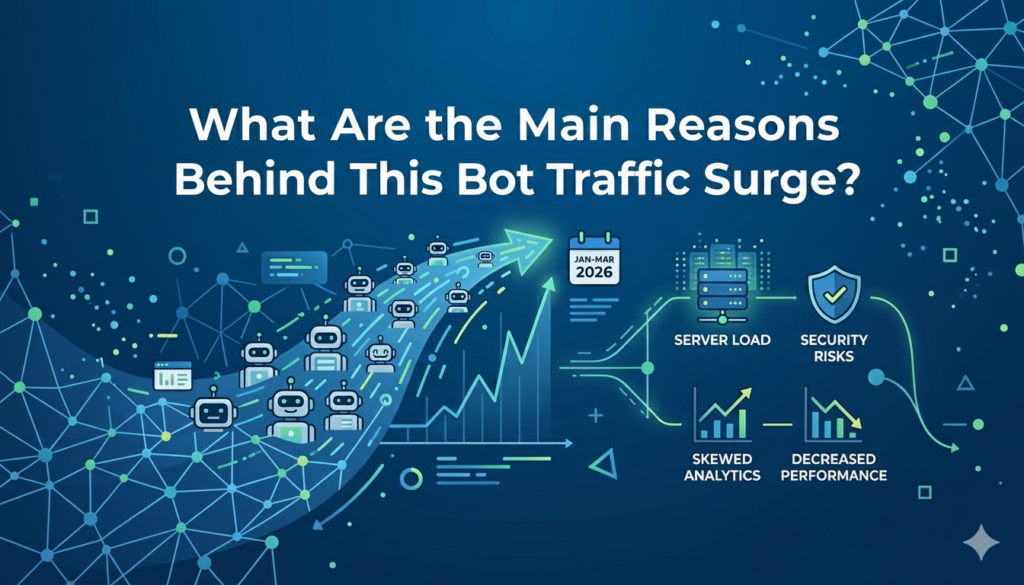
The phenomenon of increasing bot traffic across many websites has caused many website owners to wonder: what is actually the reason behind it?
So far, there is no official explanation that clearly confirms who is responsible or what the main purpose is. However, based on cybersecurity analyses and reports from website owners, there are several possible explanations.
Bot activity like this rarely happens randomly. In many cases, bots are developed for specific purposes such as data collection, system testing, or analyzing website structures.
Here are several possible explanations often discussed by experts.
1. Large-Scale Website Data Collection (Data Scraping)
One of the most likely possibilities is automated large-scale collection of public data from the internet.
Many websites contain highly valuable content such as articles, metadata, page structures, and SEO keywords. This data can be used for various technological purposes.
Bots typically visit website pages to:
- Read article text
- Retrieve page HTML structure
- Collect SEO metadata
- Analyze URL structures
- Archive public content
On a small scale, this activity has long existed on the internet. Search engines also use bots to index websites.
However, in the case of the wave of bot traffic, the scale is much larger and occurs simultaneously across many websites worldwide.
This makes the traffic appear like a surge of real visitors, even though it is actually automated data collection.
2. Data Needs for Artificial Intelligence Development
Another frequently discussed possibility is the use of website data to train Artificial Intelligence (AI) systems.
Modern AI models require extremely large datasets to understand language, writing structures, and different types of information.
Websites are a rich data source because they contain:
- Informative articles
- Latest news
- Educational content
- Diverse language structures
Bots can visit thousands of pages to collect text and information that will later be used as training data for AI systems.
Because this process is automated and performed at a massive scale, the activity can appear as mysterious traffic spikes.
3. Mapping the Global Website Ecosystem
Some cybersecurity experts suspect that bots are used to map the internet structure broadly.
In this process, bots visit various websites to understand how these sites are built and operated.
Bots can collect information such as:
- Website page structures
- Technologies used
- Content Management Systems (CMS)
- URL and navigation patterns
- How websites respond to requests
This information can be used for technology research, digital market analysis, or development of internet systems.
Although it may sound suspicious, this activity is not always harmful because it only accesses publicly available data.
4. Analysis of Advertising and Website Monetization Systems
Websites often use various digital monetization systems such as display ads or programmatic advertising.
Bots can be used to observe how advertisements are loaded and displayed on websites.
Some aspects bots may analyze include:
- Ad placement positions on pages
- How ad scripts are loaded
- Server response to ad requests
- Page structures that contain advertisements
This information can be used to understand the global digital monetization ecosystem.
However, it is important to understand that bots simply accessing pages does not necessarily mean they are attempting ad fraud.
In many cases, the activity is more like observation of publicly available systems.
5. Internet Infrastructure Testing
Some bots may also be used to measure the performance of website infrastructure.
This activity is typically conducted to understand global internet network conditions.
Bots may perform tests such as:
- Measuring server response time
- Analyzing page loading speed
- Observing website stability
- Testing responses to large numbers of requests
Testing like this is often conducted by technology companies, research institutions, or network monitoring systems.
However, when performed at a very large scale, the activity can appear as mysterious traffic spikes in analytics.
What Are the Impacts of Bot Traffic on Websites?
A surge in bot traffic may initially seem like good news because visitor graphs increase sharply. However, deeper analysis shows that the impact can extend to many aspects of a business.
This phenomenon is not just a small anomaly on a dashboard. It can affect how data is interpreted, how monetization is maintained, and even the technical stability of a website.
Here are the impacts that need to be fully understood.
1. Analytics Data Becomes Inaccurate and Biased
When bot traffic enters in large numbers, analytics systems cannot always immediately distinguish between humans and bots. As a result, the data shown on dashboards becomes mixed.
Some common changes include:
- Traffic increases sharply without marketing activity
- Visitor country distribution changes drastically (dominated by China or Singapore)
- Engagement time drops drastically
- Bounce rate rises close to 100%
- Device and browser distributions appear unusual
The main problem is not just the numbers, but interpretation. A website may think it is gaining new audiences when in fact there are no real users increasing.
In the long term, strategic decisions such as content expansion, market targeting, or SEO optimization may become misguided because the underlying data is already biased.
2. Monetization Quality and Inventory Value May Be Affected
In digital advertising, traffic quality is more important than quantity. Modern advertising systems evaluate user behavior such as visit duration, interaction, and engagement before determining inventory value.
If a website shows patterns such as:
- Extremely short visits
- No interaction
- Very high bounce rate
- Unusual geographic spikes
The system may interpret the traffic as low-quality traffic.
Possible impacts include:
- RPM or CPM becoming unstable
- Lower advertiser bidding values
- Inventory considered less stable
- Increased risk of being categorized as invalid traffic
Although it does not automatically cause penalties, large proportions of bot traffic can disrupt long-term monetization stability.
3. Infrastructure Load and Operational Costs Increase
Every bot still sends requests to the server, loads pages, and consumes resources.
On a small scale this may not be noticeable, but at large volume the impact can be significant.
Common technical symptoms include:
- The website becomes slower
- Bandwidth usage spikes
- Server CPU and RAM usage increase
- Hosting or cloud costs rise
For websites using cloud systems based on traffic or bandwidth, bot traffic surges can increase operational costs without generating additional revenue.
If not controlled, this may affect the experience of real users because the website becomes slower to access.
4. Difficult to Measure Real Organic Growth
One of the biggest impacts of the wave of unexplained bot traffic is that real growth becomes hidden by false numbers.
Websites struggle to answer important questions such as:
- Is the SEO strategy working?
- Are promotional campaigns effective?
- Is the audience actually growing?
When graphs rise due to bots, a website may feel it is growing rapidly, even though there is no real increase in readers or customers.
This can create a false sense of growth.
5. Risk of Negative Perception from Partners and Advertisers
Large traffic spikes from regions unrelated to the target market can raise questions from external parties.
Possible situations include:
- Advertisers questioning traffic quality
- Partners requesting clarification about visitor sources
- Reevaluation of collaborations
Even though the website is not manipulating traffic, anomalous data can still affect perception.
In the digital industry, inventory reputation and traffic transparency are extremely important.
What Should Website Owners Do?
Website owners do not always need to take extreme actions such as blocking entire countries immediately.
A safer approach is to analyze the data first to determine whether the traffic is truly bot activity or just an unusual visitor surge.
Here are several steps that can be taken.
1. Analyze Traffic Data in Depth
The first step is to check analytics reports more thoroughly.
Many website owners only look at pageviews or sessions, even though metrics like visit duration, bounce rate, and user interaction can reveal whether traffic comes from humans or bots.
Common signs of bot traffic include:
- Extremely short session duration
- No interaction events such as scrolling or clicking
- Many visitors from the same IP location
- Traffic appearing suddenly in large numbers
Understanding these patterns helps website owners distinguish valuable traffic from bot traffic.
2. Use Firewalls or Website Security Protection
If bot traffic becomes too large and affects website performance, the next step is implementing security systems such as firewalls or anti-bot services.
Some website security systems can automatically detect bot behavior, for example when an IP makes page requests too quickly or too frequently.
These protections can usually:
- Block suspicious IP addresses
- Limit requests from a single IP
- Identify bots attempting automated access
With proper security systems, most bot traffic can be filtered before it affects analytics data or servers.
3. Consider Limiting Traffic from Certain Countries
If analysis shows that most bot traffic comes from specific regions, website owners may consider restricting access based on country.
This can usually be done through:
- Server firewall
- CDN services such as Cloudflare
- Hosting security settings
However, this restriction should be implemented carefully. If a website has an international audience, blocking entire countries may eliminate legitimate visitors.
Therefore, this step is more suitable if bot traffic truly dominates and comes from regions irrelevant to the target audience.
4. Report Unusual Activity to Advertising Platforms
For website owners using monetization platforms such as Google AdSense or other ad networks, it is important to remain transparent about suspicious traffic activity.
If unusual traffic spikes occur, website owners can:
- Document traffic patterns
- Take screenshots of analytics reports
- Report the activity to advertising platforms
This helps prevent potential policy violations caused by bot activity outside the website owner’s control.
5. Focus on Traffic Quality, Not Just Quantity
Many website owners feel excited when they see dramatic increases in website traffic.
However, in the case of bot traffic, those large numbers do not provide real value.
High-quality traffic usually has characteristics such as:
- Longer visit duration
- Interaction with content
- Clicking on other pages
- Potential for conversion or purchases
In contrast, bot traffic only increases statistics without meaningful engagement.
Therefore, website owners should focus more on visitor quality rather than just traffic volume.
6. Monitor Traffic Developments Regularly
This bot traffic phenomenon shows that the internet ecosystem is constantly evolving and bot threats can appear at any time.
Therefore, regular traffic monitoring is essential for website owners.
By monitoring analytics data regularly, website owners can quickly detect anomalies such as:
- Sudden traffic spikes
- Changes in visitor patterns
- Suspicious activity from certain regions
The faster the issue is detected, the easier it becomes to minimize its impact.
Conclusion
The wave of unexplained bot traffic in 2026 is an important reminder that not every increase in traffic is good news. Large spikes without real interaction can actually signal automated activity on a global scale.
Although it does not currently show clear patterns of hacking or sabotage, unexplained bot traffic still carries serious impacts for websites — from biased analytics data and risks to monetization systems to infrastructure burdens.
Websites need to change their perspective on traffic. It is no longer just about pursuing high numbers, but understanding quality, behavior, and long-term business impact.
In the modern digital era, traffic quality is far more valuable than simply the number of visits.
FAQ
1. Why did a wave of bot traffic suddenly appear?
This traffic likely comes from bots performing website scanning, data scraping, or other automated activities on the internet.
2. Does bot traffic affect Google AdSense or ad monetization?
Yes. In large volumes, bot traffic can affect monetization performance such as RPM and traffic quality. If detected as invalid traffic, systems like Google AdSense may conduct additional evaluations on a website’s account.
3. How can bot traffic be identified in analytics?
Bot traffic typically shows signs such as sudden traffic spikes, extremely short visit duration, bounce rates close to 100%, and most traffic appearing as direct traffic without clear referral sources.
4. How can this wave of bot traffic be handled?
Bot traffic from China can be managed by monitoring traffic behavior patterns, using firewalls, implementing rate limiting, and filtering suspicious IP addresses. The main focus is separating bot traffic from real visitors in data analysis.
5. Can bot traffic affect a website’s SEO ranking?
Generally, bot traffic does not directly lower SEO rankings in search engines such as Google. However, if the volume is very large, bot traffic can make analytics data inaccurate, making it difficult for website owners to understand real visitor behavior and optimize SEO strategies properly.