



Point of this article..
- We reveal why focusing only on the ‘Complete’ stage means missing out on hidden monetization opportunities.
- Learn how to identify “Natural Pause Moments” like confirmation pages or status checks where users are highly attentive but less busy, making them prime real estate for non-intrusive placements.
- By mapping monetization to the actual user journey (Discover → Return), platforms can unlock incremental revenue that scales with engagement, not just conversions.
Your users spend more time ‘getting there’ than ‘being there.’ If your monetization strategy only kicks in at the finish line, you’re missing the most valuable moments of the user journey. Here is how to map, identify, and capture the hidden value in every step of the process.
Hidden Monetization Opportunities
Identifying hidden monetization opportunities in your user journey is often the key to scaling revenue. It’s a common trap: most digital platforms focus only on the final transaction, missing the value that sits right under their nose
But a closer look at user behavior reveals a different story: Users rarely jump straight to the finish line.
Instead, they browse, explore, compare, and revisit. These interactions are high-value engagement signals that are often left on the table. By understanding where attention actually peaks, platforms can uncover hidden monetization opportunities within the user journey generating value without disrupting the flow.
Understanding the User Journey on Digital Platforms
By mapping every step, platforms can visualize where hidden monetization opportunities exist beyond the primary funnel.
Across many apps and online services, the user journey typically follows a similar pattern:
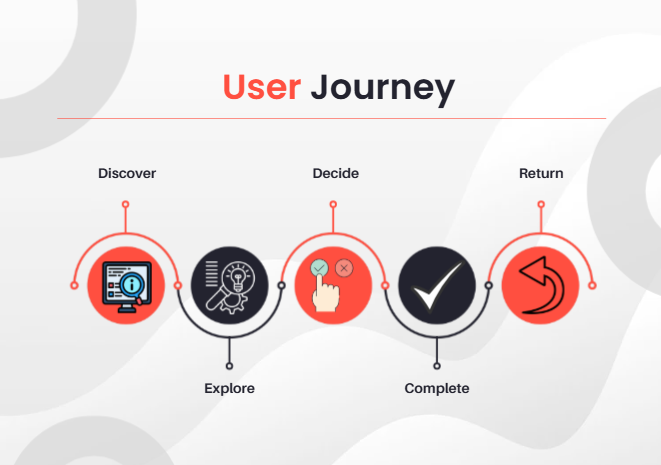
Discover
Users first encounter the platform through search, social media, referrals, or recommendations.
Explore
They begin browsing available opportunities, content, or listings.
Decide
Users evaluate options, compare details, and determine whether they want to participate or proceed.
Complete
A task is submitted, a purchase is made, or a campaign action is completed.
Return
Users revisit the platform to check updates, monitor results, or explore new opportunities.
Many digital platforms place their entire monetization strategy on the Complete stage. However, behavioral data often shows that users spend significantly more time in the Explore and Decide stages.
This is where engagement is strongest and where user journey monetization opportunities for digital platforms may begin to emerge.
Identifying High Attention Moments
These high-attention moments are the primary drivers for hidden monetization opportunities that most operators overlook.
High attention moments occur when users are actively interacting with a digital product.
These moments often include actions such as:
- browsing available campaigns or opportunities, products, or services
- reviewing detailed information about tasks or listings
- comparing multiple options
- checking progress or status
- revisiting the platform multiple times
From a behavioral perspective, these activities signal strong intent and sustained engagement.
For platform operators exploring how to monetize high engagement user journeys, these stages represent valuable attention that exists before any final transaction takes place.
At ProPS, we observe, rather than interrupting the experience with aggressive monetization, many platforms are beginning to explore more contextual approaches that align naturally with these engagement moments.
The goal is not to add more ads, but to better understand where attention already exists.
The Importance of Natural Pause Moments
Exploiting natural pauses allows for hidden monetization opportunities to feel like a value-add, not a distraction.
Another often overlooked opportunity lies in what can be called natural pause moments.
These are points in the user journey where interaction briefly slows down. The user has completed an action and is momentarily waiting for the next step.
Examples of natural pause moments include:
- after submitting a task or application
- viewing a confirmation or completion page
- checking reward or payment status
- reviewing completed activities
- waiting for approval or results
These moments are particularly interesting from a monetization perspective because they occur between actions rather than during them.
For digital services looking at non-intrusive advertising placements within user journeys, these pause points can be more suitable for lightweight placements that do not interfere with the core interaction.
Because the user is already transitioning between actions, these placements tend to feel more natural within the flow of the experience.
A Simple Framework: The User Journey Monetization Map
When platforms begin mapping engagement patterns across their product, monetization opportunities often become clearer.
A simplified view might look like this:
| User Journey Stage | Engagement Behavior | Potential Monetization Moment |
| Discover | users arrive via search or social | contextual discovery placements |
| Explore | browsing opportunities or listings | lightweight display placements |
| Decide | reviewing details and comparing | contextual recommendations |
| Complete | submitting tasks or purchases | confirmation page placements |
| Return | checking results or status | status or dashboard placements |
This type of framework helps teams think about best practices for monetizing user traffic on digital platforms without relying entirely on the final conversion moment.
Instead, monetization becomes something that follows user behavior rather than interrupting it.
Rethinking Monetization Beyond Transactions
As digital platforms evolve, engagement itself is becoming one of the most valuable assets.
Users may return multiple times, explore numerous opportunities, and spend significant time interacting with a platform before completing a single transaction. Each of these interactions contributes to the overall attention economy of the product.
For platform operators exploring how to monetize user engagement without hurting UX, the key lies in identifying moments where monetization aligns naturally with user behavior.
Rather than forcing monetization into the experience, successful strategies often emerge from observing how users move through the platform and recognizing where attention peaks.
By focusing on high attention moments and natural pause moments, digital platforms can uncover hidden monetization opportunities within the user journey while maintaining a smooth and user-friendly experience.
Conclusion
Not all valuable engagement happens at the point of conversion.
In many digital platforms, the majority of user attention occurs earlier in the journey while browsing, comparing, or returning to monitor progress.
By understanding the full flow of Discover → Explore → Decide → Complete → Return, platform operators can begin identifying previously overlooked opportunities within their product experience.
When approached thoughtfully, these moments allow monetization strategies to evolve alongside user behavior creating value without compromising the experience that keeps users coming back.
“Ready to uncover the hidden value in your user journey? Contact the ProPS team today for a strategic monetization audit.”
FAQ
- What exactly is a “Natural Pause Moment” in a user journey?
It’s a transition point where a user has finished one task and is waiting for the next, such as a “Task Submitted” screen or a “Status Tracking” page. Since the user isn’t focused on a complex action, they are more receptive to relevant, lightweight information. - Will monetizing the “Explore” or “Decide” stages distract users from converting?
Not if it’s done contextually. At ProPS, we advocate for non-intrusive placements that align with user intent. The goal is to provide value (like a relevant recommendation) rather than a distraction that breaks the flow. - Why is the “Return” stage considered a hidden goldmine?
Users returning to check results or status are “high frequency” visitors with high trust in the platform. These moments offer sustained attention that is often left completely unmonetized in traditional setups. Finding hidden monetization opportunities is about observing user behavior, not just counting clicks. - How do I know which stage of my user journey is ready for monetization?
Look at your behavioral data. Stages with high “Time Spent” but low “Revenue Per User” are your primary candidates. Use our User Journey Monetization Map to identify where attention peaks and ad density is low. - Does this strategy require a massive UX revamp?
No. Most of these opportunities can be captured using existing “white space” in your app or web flow. It’s about strategic placement, not redesigning the entire product.