



Point of this article..
- Platforms are winning the battle for attention but losing the battle for profit. We explore why growing user metrics often fail to translate into proportional revenue and how rigid monetization structures are to blame.
- Monetization is typically crowded on homepages or primary funnels. We identify high-value “blind spots” such as post-transaction screens and status tracking where user attention is peak, yet ad density remains zero.
- Scaling revenue doesn’t require more traffic; it requires better timing. By aligning ads with “natural pauses” in the user journey, platforms can unlock new revenue streams that feel like value adds rather than interruptions.
High Engagement Doesn’t Guarantee Revenue. Here’s Where Platforms Are Losing Monetization Opportunities.
Across today’s digital landscape, platforms are becoming increasingly effective at attracting and engaging users.
From content consumption to interactive features, users are spending more time and performing more actions than ever before.
Yet, many platforms face a familiar challenge: User engagement is growing, but revenue isn’t scaling at the same pace.
This gap often isn’t caused by a lack of traffic or activity, but by how monetization is structured within the user journey.
The Monetization Gap Most Platforms Overlook
In many cases, monetization is concentrated in a few predictable areas:
- main landing pages
- content-heavy sections
- key conversion points
While these placements generate value, they represent only a fraction of the total opportunity.
What’s often missing is a broader view: Monetization should align with how users interact across the entire journey, not just where they enter or exit.
Where Opportunities Are Commonly Missed
Based on common platform behaviors, several high value moments are frequently underutilized:
1. Post Action Moments
After completing an action such as submitting a form, finishing a process, or confirming a transaction, users enter a natural pause.
At this stage:
- attention is still present
- the primary task is complete
- users are more open to additional interaction
However, these moments are often left unmonetized or underutilized.
2. Progress and Status Interactions
Users often return to platforms to check:
- updates
- results
- progress
- status changes
These repeat visits create consistent engagement over time.
Despite this, these pages are rarely optimized for monetization, even though they can generate meaningful impression volume with strong user attention.
3. Decision Oriented Interactions
Before taking action, users tend to explore:
- options
- details
- comparisons
These interactions signal a higher level of intent and focus.
However, monetization in these areas is often either too aggressive or too limited, reducing its effectiveness.
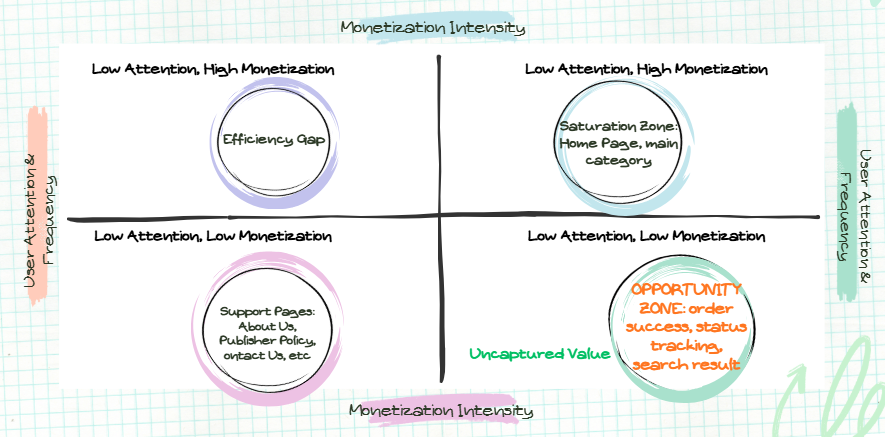
“The goal isn’t to show more ads, but to make sure every ad shown is in the right place at the right time. When you shift your strategy from the ‘Saturation Zone’ to the ‘Opportunity Zone’, you stop interrupting the user and start providing value.“
Why These Gaps Exist
There are several reasons why platforms fail to capture these opportunities:
1. Monetization Is Treated Separately from Product Design
In many organizations, monetization is implemented after the core experience is built, rather than being integrated into it.
2. Over-Reliance on Standard Placements
Traditional placements continue to dominate, even as user behavior evolves.
This limits the ability to adapt monetization strategies to real user interactions.
3. Concerns About User Experience
There is often hesitation to introduce monetization in key moments due to fear of disrupting the experience.
While this concern is valid, it can lead to missed opportunities when not approached thoughtfully.
A More Effective Approach to Monetization
Platforms that perform well take a different approach.
Instead of focusing solely on placement, they focus on timing and context.
Key Principles:
1. Align Monetization with User Flow
Integrate monetization into natural interaction points rather than forcing it into fixed locations.
2. Prioritize Relevance Over Volume
Not all impressions carry the same value. Moments with higher engagement often deliver better results.
3. Maintain a Non-Disruptive Experience
Use formats and placements that complement the experience rather than interrupt it.
Unlocking Untapped Value
Improving monetization does not always require more traffic or more aggressive ad strategies.
Often, the opportunity lies in: making better use of existing user engagement
By identifying where attention is already strong and aligning monetization accordingly, platforms can unlock additional value without compromising the overall experience.
Conclusion
As digital platforms continue to evolve, so do user expectations and behaviors.
Success in monetization will increasingly depend on understanding not just how many users you have, but: how, when, and where they engage
Many platforms already have the building blocks in place.
The next step is recognizing where value is being created and ensuring it is not left uncaptured.
FAQ
- Will adding ads to “The Opportunity Zone” hurt the User Experience (UX)?
No. By placing ads in “natural pauses” (e.g., after a successful transaction), you avoid interrupting the user’s primary task. When done contextually, it feels like a helpful recommendation. - Why are “Post Action” moments so valuable?
At this stage, users have completed their goal and are in a state of “Cognitive Reset.” They are still attentive to the screen but more open to new information, leading to significantly higher CTRs. - My traffic is high, but revenue is stagnant. What’s wrong?
You likely have a “Monetization Gap.” You are over relying on saturated standard placements. You need to audit your user journey to find untapped moments where attention is high but ad density is low. - Is this strategy only for E-commerce?
It applies to any digital ecosystem fintech, utility apps, or talent portals. Any platform with a user journey has transition moments that can be strategically monetized. - How does ProPS help identify these gaps?
We combine audience data analysis with GCPP expertise to map your user journey, identifying the most efficient, UX-safe points to inject new revenue streams.