



Point of this article:
- Beyond Banners: Building a Retail Media Network (RMN) isn’t just about adding ad slots; it’s about creating a scalable, data-driven ecosystem.
- The 4 Pillars: Successful monetization is built on four core foundations: Audience, Inventory, Advertiser Demand, and Data Infrastructure.
- The Power of Intent: The true value of retail media isn’t just traffic; it’s the proximity to the Point of Purchase.
- Closed-Loop Measurement: Connecting ad exposure directly to sales outcomes is the “holy grail” that attracts top-tier brand budgets today.
The Retail Media
Retail media is booming, and every major retailer wants a piece of the pie. But here’s the reality we see often as consultants: many launch sponsored banners, only to wonder why the revenue hits a ceiling so fast.
The truth? A successful Retail Media Network (RMN) isn’t just about having a website with ad slots. It’s about building a structured ecosystem that connects user intent with advertiser demand.
From our perspective at ProPS, there are four pillars that separate a “feature” from a “business.”
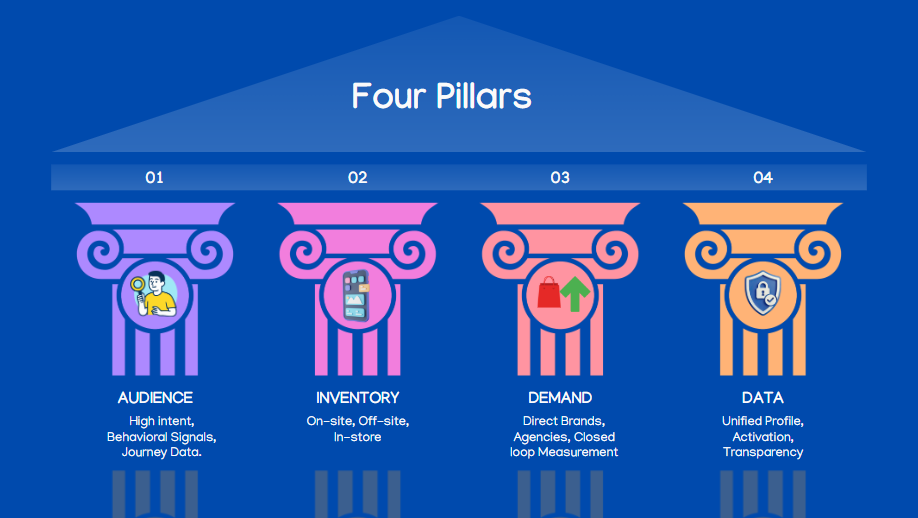
1. Monetizable Audience
The first question is not about ad formats or technology. It is about the audience.
Retailers already attract millions of users across their digital ecosystems. These audiences represent high-value opportunities because they are closer to the point of purchase than users on traditional media platforms. For brands, this context is gold; ads reach consumers who are actively exploring, comparing, or preparing to buy.
However, audience size alone is not enough. The real value lies in behavioral signals such as:
- Product exploration & category browsing
- Repeat visits & loyalty patterns
- Cart interactions & purchase history
The more clearly a retailer understands these signals, the more valuable its inventory becomes. Audience intelligence is the foundation of monetization.
2. Monetizable Inventory
Retail media inventory is broader than many assume. It goes far beyond traditional banners. Typical monetization surfaces include:
- On-site: Sponsored products in search results, recommendation widgets, and product listing placements.
- Off-site: Audience targeting on external websites and retargeting using retailer first-party data.
- In-store Digital: Digital screens, smart shelves, and in-store audio.
The ProPS Rule: Design ad placements that integrate naturally. Overly intrusive formats damage the user experience. Effective monetization should enhance product discovery, not disrupt it.
3. Advertiser Demand
Retail media turns retailers into media owners. This means you must think like an advertising platform, not just a merchant. To attract brands, you need a clear value proposition:
- High-intent audience segments.
- Precise targeting using first-party data.
- Closed-loop measurement: Connecting ad exposure directly to purchase outcomes.
This visibility makes retail media one of the most accountable forms of digital advertising. However, scaling demand requires operational muscle: campaign management, advertiser support, and performance reporting. This complexity is often where retailers underestimate the resources needed.
4. Data and Measurement Infrastructure
The final pillar and often the most critical is the infrastructure. Retail media is powered by first-party data (purchase behavior, browsing patterns, and loyalty data).
But data alone is not enough. It must be unified across systems to enable:
- Real-time targeting and personalization.
- Campaign optimization.
- Identity resolution (knowing the user across devices).
A strong data foundation allows retailers to move beyond simple placements toward behavior driven monetization strategies.
The Role of Monetization Strategy
Launching a few sponsored placements is relatively easy. Building a scalable business is not. It requires aligning audience insights, inventory design, demand generation, and data infrastructure.
Without this alignment, RMN initiatives struggle to demonstrate measurable value. From a consulting perspective, our goal at ProPS is to design an ecosystem where advertising, commerce, and user experience reinforce each other.
Conclusion
Retail media should not be treated as an experimental “add-on.” It is a long term revenue driver. For retailers looking to unlock their platform’s full potential, the shift from “merchant” to “media owner” requires a shift in strategy: from selling space to selling outcomes.
FAQ
- How much traffic do I really need to start a Retail Media Network?
While traffic matters, data quality is often more crucial. Niche retailers with rich purchase history can be more attractive to brands than giant platforms with generic data. It’s about the intent behind the eyes, not just the volume. - Will adding ads to my platform ruin the shopping experience?
If done poorly, yes. But a smart strategy enhances UX. Relevant sponsored products help users find what they need faster. At ProPS, we focus on “Discovery First” ads, the ad should feel like a helpful recommendation. - What is the biggest hurdle retailers face when scaling?
Data Silos. Most retailers have plenty of data, but it’s locked in separate systems. Unifying this data for transparent reporting is where most struggle and where a structured strategy becomes essential. - Do I need a massive in-house sales team from day one?
Not necessarily. Many start with a hybrid model, using monetization partners like ProPS to build the framework and technology first, then scaling internal teams as revenue grows. - How do we measure the true ROI of Retail Media?
ROI isn’t just direct ad spend. It includes strengthened supplier relationships, deeper behavioral insights, and increased enterprise value. We help retailers look beyond the “click” to the long-term impact on the bottom line.
Ready to turn your platform into a high-growth media business? [Contact ProPS today for a monetization audit.]