



Points of this article…
- The metric most advertisers are missing: AI visibility, not just search ranking. In a world where your brand is being discussed by AI in 48% of all queries, traditional rankings are losing their grip. When an AI summary appears, users click traditional results only 8% of the time, making “AI Presence” the only metric that truly secures your brand’s future.
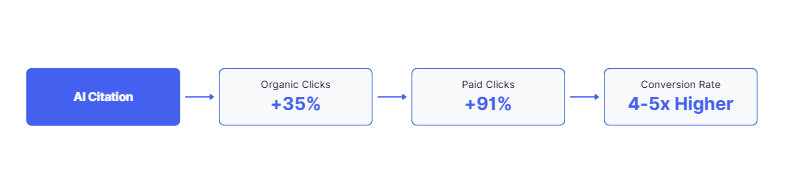
- Being cited in AI answers creates a halo effect across all channels. Brands cited in AI Overviews earn 35% more organic clicks and 91% more paid clicks. GEO isn’t separate from paid media strategy, it amplifies it. And AI-referred visitors convert at 4 to 5 times the rate of traditional search visitors.
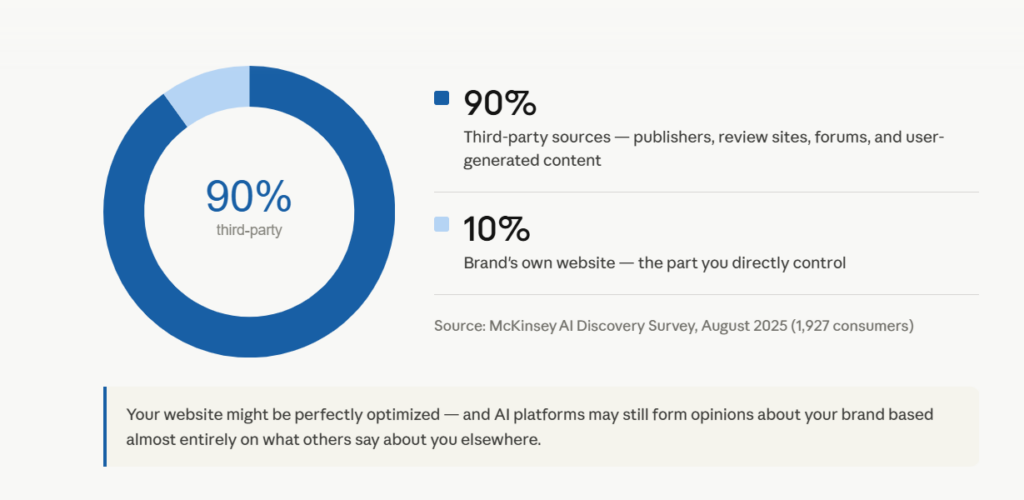
- Your website controls only 5–10% of your AI brand narrative. AI platforms form opinions about your brand based 90% on what others say about you; publishers, reviews, forums, UGC. Your PR strategy, earned media, and third-party mentions are now direct inputs into how AI represents your brand.
Brand visibility in AI-generated answers is the new battleground for advertisers. Here’s what the data says, and what to do about it.
When a user asks Gemini or ChatGPT for a recommendation, your brand is either the hero of that story or it simply doesn’t exist. There is no ‘Page 2’ to hide on anymore. In this new winner-take-all interface, ranking #1 on Google is a hollow victory if an AI summary above it is pointing your customer toward a competitor. This isn’t a future threat, it’s the new baseline for digital survival.
AI Overviews now trigger on 48% of Google queries, and Pew Research found that users click traditional search results only 8% of the time when an AI summary appears. That’s the world advertisers are operating in right now. The question is no longer just “where do we rank?” It’s “do we show up in the answer at all?”
This is the second piece in our GEO series. The first looked at how publishers are losing traffic to AI extraction. This one focuses on what it means for brands and advertisers, and why brand visibility in AI answers is quickly becoming the most important metric in digital marketing.
The Metric That Most Advertisers Are Missing
Most brand measurement frameworks were built for a world where visibility meant ranking on page one. That world isn’t just changing; it’s being re-architected. We are moving from a Click-First Economy to a Citation-First Reality.
AI platform visits grew 28.6% between January 2025 and January 2026. Over the same period, AI referrals to external websites were essentially flat. More people are using AI platforms more often, but they are not clicking through to external sites at a higher rate. The platforms are retaining attention, not distributing it.
This creates a visibility gap that traditional metrics simply don’t capture. A brand can rank #1 on Google and still be completely absent from the AI answer that the same user sees five seconds later. Major publishers like Reuters and The Guardian receive less than 1% of referral traffic from AI platforms like ChatGPT and Perplexity despite being frequently cited. Visibility and traffic are no longer the same thing.
For advertisers, this matters for a simple reason: if AI is shaping what people think before they click anything, then brand presence inside AI answers is influencing purchase decisions at a stage that your current reporting isn’t measuring.
The Halo Effect Nobody Is Talking About
Here’s the data point that should change how advertisers think about GEO. Brands cited in AI Overviews earn 35% more organic clicks and 91% more paid clicks compared to those left out entirely. Securing a spot in an AI citation is a force multiplier. It’s not just a vanity mention; it’s a performance catalyst that de-risks your ad spend.
That’s not a small lift. 91% more paid clicks means that your existing ad budget performs significantly better when your brand is already showing up in AI-generated answers. GEO and paid media aren’t separate strategies, they amplify each other.
The Washington Post found that visitors from AI platforms converted to subscriptions at 4 to 5 times the rate of traditional search visitors. The volume is lower, but the quality is dramatically higher. Users who arrive via AI citation have already been pre-qualified by the AI, they clicked because they wanted to go deeper, not because they stumbled across a link.
For advertisers, this reframes the GEO conversation entirely. It’s not just a content strategy. It’s a performance strategy.
Where Your Brand Actually Stands in AI Answers
Most brands are operating with a massive narrative blind spot. You might own your domain, but you no longer own your reputation, the LLMs do.
A brand may appear as the number one recommendation in Gemini, be entirely absent in ChatGPT, and be mis-categorized in Perplexity; all in the same week. Each AI platform draws from different sources, updates at different rates, and synthesizes information differently. Assuming your brand is well-represented because your SEO is strong is a mistake.
A McKinsey analysis found that a brand’s own website accounts for only 5 to 10% of the sources AI search platforms reference. The other 90% comes from publishers, user-generated content, affiliate sites, and review platforms.
This is the part that tends to surprise advertisers the most. Your website might be perfectly optimized, but AI platforms are forming opinions about your brand based almost entirely on what other people say about you elsewhere. Third-party mentions, review sites, editorial coverage, and forum discussions, these are shaping your AI brand narrative more than your own content is.
What GEO Actually Requires From Advertisers
The investment signal is clear. An average of 12% of 2025 digital budgets was allocated to GEO initiatives, while 32% of digital leaders declared GEO their top priority for 2026. This investment growth outpaces increases in paid channel allocations.
But throwing a budget at GEO without a clear strategy won’t work. 97% of digital leaders surveyed already report a positive impact from their GEO efforts, which means the methodology is sound, but it requires the right approach.
Here’s what actually moves the needle for brand visibility in AI answers:
Build content that answers questions directly. The first sentence of a page should answer the primary question completely, because AI engines are looking for that quick validation. Every section should stand alone, since AI engines pull individual chunks. This is a different writing discipline from traditional SEO content, and it requires a real shift in how content teams work.
Earn mentions beyond your own site. AI engines draw from Reddit, LinkedIn, YouTube, and review sites; ranked among the most-referenced domains by major large language models in late 2025. Your PR strategy, partnership content, and community presence are now direct inputs into your AI brand visibility. This is why GEO is making earned media relevant again in ways it hasn’t been in years.
Build topical authority, not just keyword coverage. AI engines favor sources that demonstrate deep expertise on a topic. Rather than publishing scattered blog posts across dozens of topics, build comprehensive content clusters that cover a subject thoroughly. Brands with genuine depth in a specific area will consistently outperform brands chasing volume across many topics.
Measure what AI is saying about you. Brands can’t optimize what they don’t measure. A simple starting point: list 10 to 15 questions your ideal customer would ask an AI engine, then track how your brand appears across ChatGPT, Gemini, and Perplexity monthly. The answers will tell you where your narrative is accurate, where it’s incomplete, and where AI is saying something about your brand that you didn’t intend.
The Paid Advertising Angle
GEO matters for organic brand visibility, but the paid advertising opportunity inside AI is growing fast too. Ads now appear in 25.5% of AI Overview results, a 394% increase from early 2025. U.S. AI search ad spending is projected to reach $2.08 billion in 2026 and grow to $25.93 billion by 2029.
AI-driven search advertising is projected to grow from just over $1 billion in 2025 to nearly $26 billion by 2029. That’s the scale of what’s being built. And for advertisers, the brands that have already built organic GEO presence will be better positioned to amplify that with paid investment, because the AI ecosystem already recognizes them as relevant sources.
The brands treating GEO and paid media as separate conversations are making a strategic mistake. They feed each other.
The Bottom Line for Advertisers
The decision-making journey for your customers has changed. They’re asking AI systems for recommendations, comparisons, and advice; and AI is answering based on what it finds across the web, not just on your website.
AI tools have been constantly shaping brand perception, affecting buyer decisions, and curating vendor shortlists. What’s being rewarded by AI systems today is authoritative and well-structured content that offers clear insights.
The brands that show up consistently in AI answers aren’t just more visible, they’re more trusted, they earn more clicks when users do decide to search further, and their paid media performs better because of the halo effect.
While AI referral traffic is often lower in volume than traditional search traffic, those visitors convert at higher rates because they enter the decision-making process later. Fewer visits, but better ones.
That’s the GEO opportunity for advertisers: not more traffic, but better-qualified audience at every stage of the funnel including stages that your current measurement framework probably doesn’t even track yet.
In the next piece in this series, we’ll look at GEO from the content and technical side; specifically, what it takes to build content that AI systems actually want to cite.
As Indonesia’s digital ecosystem rapidly integrates AI, staying ahead of the citation curve is no longer an option, it’s a survival mandate.
ProPS helps brands and publishers build the content and distribution infrastructure to stay visible as AI reshapes discovery. If you’re thinking through your GEO strategy, we’d like to talk.
FAQ
Q: Does GEO replace paid advertising for brands?
No, and thinking of it that way misses the point. GEO and paid advertising work best together. Brands with strong AI visibility tend to see better performance from their paid media because of the halo effect, users who’ve already encountered a brand in an AI answer are more likely to click its ad and convert when they see it later. The two channels reinforce each other rather than compete.
Q: How do I know if my brand is showing up accurately in AI answers?
Start manually. List 10 to 15 questions your target customers would ask an AI engine, things like “best [your category] for [use case]” or “how does [your brand] compare to [competitor].” Run those queries across ChatGPT, Google AI Overview, Gemini, and Perplexity and record what comes back. You may find your brand is absent in some platforms, misrepresented in others, or described with outdated information. That baseline is where GEO strategy starts.
Q: Our SEO is strong. Doesn’t that mean our GEO is fine too?
Not necessarily. SEO and GEO pull from overlapping but different signals. Strong SEO helps, AI platforms do frequently reference top-ranking Google results, but it’s not sufficient on its own. AI draws heavily from third-party sources like review sites, Reddit, LinkedIn, and editorial coverage. A brand with excellent SEO but weak earned media or thin third-party presence may still have poor AI visibility. GEO requires attention to the full web footprint, not just owned content.
Q: What’s the difference between GEO and AEO?
GEO (Generative Engine Optimization) is the broader practice of optimizing your brand’s presence so that AI systems cite and recommend you. AEO (Answer Engine Optimization) is a subset focused specifically on structuring content so it gets pulled into direct answers, the featured snippet equivalent for AI. They overlap significantly and work together, but GEO is the more comprehensive term that covers content strategy, earned media, schema markup, and brand narrative management across the web.
Q: How quickly can GEO improvements show results?
Faster than most people expect, but not overnight. Technical changes like schema markup and content restructuring can start influencing AI citations within weeks, since AI platforms update their indexes frequently. Earned media and third-party mention building takes longer typically three to six months to meaningfully shift how AI represents your brand. Measurement improvements, like tracking your AI citation share monthly, give you visibility into whether the changes are working before traffic numbers shift
Sources
- Jarred Smith / MarTech; AI Search Visibility 2026 Data (April 2026)
- Similarweb 2026 GenAI Brand Visibility Index via ALM Corp (March 2026)
- Search Engine Journal / Geoptie; GEO Strategies 2026 (March 2026)
- PR News Online; AI Search Is Stealing Your Traffic (January 2026)
- MarTech / Conductor Research; Competition for Brand Visibility (February 2026)
- EMARKETER; FAQ on GEO and AEO (April 2026)
- Fast Company; Why AI Visibility, GEO, and AEO Are the Future (February 2026)
- DesignRush / Reuters; Why GEO Is Replacing SEO (May 2026)