The Paradigm Shift: Why Retail Media is no longer just a “side project” but a core revenue driver for digital platforms.
Retail Media vs Commerce Media: How the industry is evolving from closed ecosystems to the open-web powerhouse.
The Intent Advantage: Why transactional data is becoming the “Gold Standard” in a post-cookie advertising world, especially for platforms in Indonesia’s fragmented market.
Most people think Retail Media is just about putting banners on an e-commerce site. They’re wrong. It’s evolving into something much bigger, and it’s called Commerce Media.
Companies like Amazon, Walmart, and Target have proven how successful this model can be. Today, retail media is one of the fastest-growing segments in digital advertising.
However, as the ecosystem matures, a broader concept is starting to gain attention: Commerce Media.
While the two terms are often used interchangeably, they represent different stages in the evolution of digital monetization.
Understanding this distinction is becoming increasingly important for platforms that want to unlock new revenue opportunities.
From our perspective at ProPS, retail media is only the beginning. Commerce media represents a much larger opportunity.
The Rise of Retail Media
Retail media refers to advertising opportunities that exist within a retailer’s owned ecosystem. This typically includes placements across e-commerce websites, mobile apps, search results, product listing pages, and sometimes even in-store digital screens.
What makes retail media particularly powerful is its access to first-party commerce data. Retailers have visibility into browsing behavior, product interests, and purchase history, which allows brands to target highly relevant audiences.
More importantly, retail media operates close to the moment of purchase. When consumers are already browsing products, the probability of converting an ad into a sale increases significantly.
This is why advertisers increasingly allocate budgets toward retail media. It provides something many traditional digital channels struggle with: clear attribution between advertising and actual sales.
In Indonesia, we are already seeing the growth of retail media ecosystems. Major platforms such as Tokopedia, Shopee, and Blibli offer various forms of sponsored product placements, search ads, and display ads that brands can use to promote their products within the marketplace environment.
These models closely mirror what global leaders like Amazon pioneered.
For many retailers, retail media has become a critical revenue driver that complements their core commerce business.
The Limitations of Retail Media
Despite its rapid growth, retail media has a natural limitation: it is confined within the retailer’s own ecosystem.
This means advertising opportunities are largely limited to the traffic generated by that specific platform. While this traffic may be valuable, it still represents only a portion of the broader consumer journey.
Consumers do not start and end their journey within a single retail platform. They discover products on social media, compare prices on marketplaces, read reviews on content sites, and complete purchases across multiple channels.
As a result, advertisers increasingly seek ways to reach consumers across multiple touchpoints, not just within a single retailer’s environment.
This is where the concept of commerce media begins to emerge.
What Is Commerce Media?
Commerce media expands the retail media model beyond a single retailer’s ecosystem. Instead of relying on data from one platform, commerce media leverages transactional and behavioral data from multiple commerce environments to power advertising.
In other words, commerce media uses signals from commerce activity such as purchases, product searches, and transaction patterns to create advertising opportunities across a broader network of digital channels.
This means commerce media can extend beyond retail platforms to include a wide range of digital services that generate transactional data.
For example, platforms in sectors such as travel, food delivery, ride-hailing, and financial services can also become part of the commerce media ecosystem.
In Indonesia, several platforms already possess the ingredients required for commerce media.
Companies like Gojek and Grab generate enormous volumes of transaction data through ride-hailing, food delivery, and digital payments.
Similarly, travel platforms such as Traveloka capture high-intent signals from users planning trips and bookings.
These behavioral signals are extremely valuable for advertisers because they reveal real consumer intent, not just browsing activity.
In a commerce media framework, these signals can be activated to create advertising opportunities both within the platform and across external media channels.
Retail Media vs Commerce Media
The easiest way to understand the difference is to look at scope and scale.
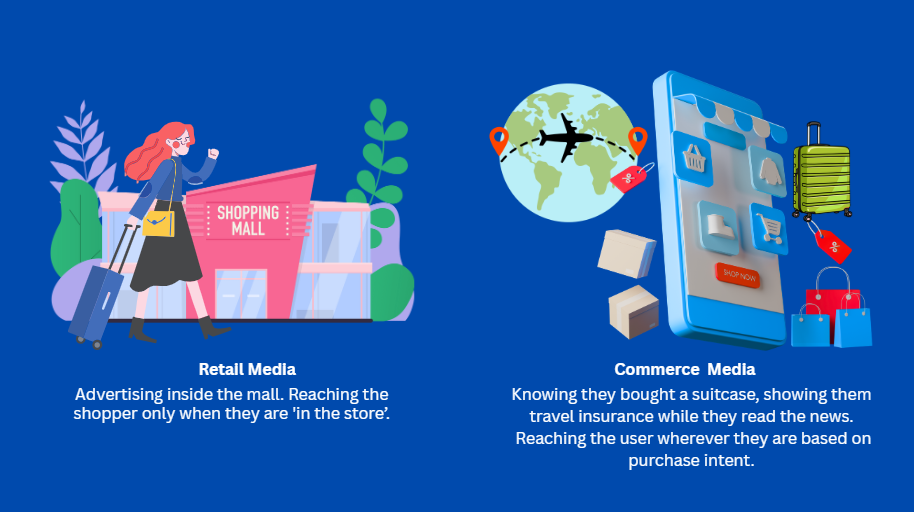
While Retail Media focuses on monetizing advertising within a retailer’s own properties, Commerce Media expands that idea by using commerce data to power advertising across a broader, open-web ecosystem.
To put it simply: If Retail Media is like advertising inside a physical mall, Commerce Media is like knowing a customer bought a suitcase yesterday and showing them a travel insurance ad while they’re reading the news today.
Retail media is typically bottom-funnel oriented, targeting users who are already close to making a purchase.
Commerce media, on the other hand, enables full-funnel marketing reaching consumers during discovery, consideration, and purchase stages, regardless of where they are on the internet.
Another key difference lies in the types of advertisers involved. Retail media primarily attracts brands selling products within the retailer’s platform.
Commerce media can support a wider range of advertisers, including non-endemic brands that want to reach audiences based on behavioral signals.
For example, a user who frequently books flights on Traveloka might be a valuable audience for banks, insurance providers, or lifestyle brands even if those brands are not directly selling travel products.
This broader applicability is one of the reasons commerce media is gaining traction globally.
Why Commerce Media Matters for the Future
The shift toward commerce media is happening for several reasons.
First, first-party data is becoming increasingly valuable as third-party cookies continue to disappear. Platforms that own transactional data have a significant advantage in building privacy-safe advertising ecosystems.
Second, advertisers are looking for ways to connect marketing spend more directly to business outcomes. Commerce data provides strong signals that can improve targeting, measurement, and attribution.
Finally, many digital platforms are beginning to realize that their value extends beyond the services they provide. The data generated by user activity can become the foundation of entirely new monetization models.
From a strategic standpoint, this is where platforms can begin to evolve from digital services into media ecosystems.
A Strategic Opportunity for Platforms
At ProPS, we believe that the future of digital monetization will increasingly revolve around commerce-driven media ecosystems.
Retail media has already demonstrated how powerful commerce data can be when applied to advertising. Commerce media takes this concept further by expanding the scale of that data and applying it across multiple environments.
For platforms that understand how to activate their transaction data effectively, the opportunity is significant.
What starts as a commerce platform can eventually evolve into something much more powerful: a data-driven media platform built on real consumer behavior.
And in the coming years, that transformation may define the next chapter of digital monetization.
FAQ
Does my platform need millions of users to start Commerce Media? Not necessarily. While scale is great, Commerce Media is a game of Intent, not just reach. A platform with 100,000 users who are actively buying high-value items is often more valuable to advertisers than a platform with millions of passive scrollers. It’s about the quality of your signals, not just the quantity of eyeballs.
How is this different from regular programmatic advertising? Regular programmatic ads often rely on third-party cookies which are unreliable and slowly disappearing. Commerce Media uses actual purchase history and transactional data. This is the “Gold Standard” of data because it’s based on what people actually do, not just what they might be interested in. It’s the difference between guessing and knowing.
Is it safe for user privacy? Absolutely. Commerce Media is built on First-Party Data. Since the data is collected directly from your own users within your own ecosystem, it is inherently more privacy-compliant than buying data from third-party brokers. In a post-cookie world, this “trusted relationship” between a platform and its users is your most valuable asset.
Can non-retail platforms (like Fintech or Travel) really do this? Yes, and they should. Any platform that captures transactional intent (booking a flight, paying a utility bill, ordering food) has the foundation for a Commerce Media business. Advertisers are hungry for these signals to reach specific audiences at the right time.