



Point of this article..
- App monetization converts users into revenue. Every activity in the app can generate money if managed with the right strategy.
- The right ad formats determine revenue. Rewarded Video, Interstitial, Banner, and App Open Ads have different characteristics and significant impacts.
- Ad platforms support optimization. AdMob, Google Ad Manager, and AdX help increase revenue and access to premium demand.
Do you have thousands or even millions of app downloads, but your revenue still feels small? Many publishers experience the same thing because they do not yet understand app monetization strategies comprehensively. So, what is app monetization?
App monetization is not just about displaying ads in an app. It is a strategy on how an application generates revenue consistently, measurably, and continues to grow. Without the right strategy, even massive traffic can feel like “busy but not profitable.”
This article discusses comprehensively what app monetization is, how it works, the most commonly used models, and the important roles of platforms like Google AdMob, Google Ad Manager, and Google Ad Exchange in increasing revenue.
What is App Monetization and Why is it Important?
Simply put, app monetization is how an application makes money from users. Like a shopping mall, your app is the building, while monetization is the tenant rental system inside it. Without the right system, a building can be crowded with visitors but not generate maximum profit.
Technically, app monetization works by leveraging traffic and user activity within the app as assets that have economic value. Every time a user opens the app, interacts with certain features, or views an ad, there is potential value that can be converted into revenue.
If we talk about App Monetization, we are talking about a chain of processes that lock together, starting from how we choose a business strategy, determine the types of ads that appear, to how that money eventually lands in our bank account.
Everything is interconnected in one monetization ecosystem.
Determining Strategy: Choosing the Right Monetization Model
Before going into the technicalities of ads, you must determine which “door” will be your main source of income. The monetization model is the foundation of your business.
- In-App Advertising (IAA): This is the most popular choice for free apps. You let users enjoy features for free, but you “rent out” space within the app for advertisers.
- In-App Purchase (IAP): This model focuses on selling digital items. In games, this can be weapons or lives; in productivity apps, it can be extra storage quotas.
- Subscription: This model is very healthy for the long term because it creates recurring revenue. Users pay weekly, monthly, or annual fees for access to exclusive content (like streaming services or premium journals).
- Freemium Model: This is a combination where basic features are provided for free, but “power” features are locked. Often, this model is combined with a “Remove Ads” option for those who feel bothered by ads.
- Sponsorship & Partnership: If your app has a very specific user base (e.g., a mountain hiking community app), you can work directly with outdoor equipment brands to promote their products exclusively.
How Does App Monetization Work?
All the formats above don’t just appear out of nowhere. There is an automated system behind the scenes that works in milliseconds:
- The user opens the app.
- The ad system reads the ad impression opportunity.
- Advertisers perform bidding (automated auction).
- The ad with the highest value is displayed.
- The publisher receives payment based on views or clicks.
Revenue is usually calculated using:
- CPM (payment per 1,000 views)
- CPC (payment per click)
- eCPM (effective estimated revenue)
The higher the quality of traffic and the more competitive the ad demand, the greater the revenue potential. In ad-based monetization, there are four main formats that are most frequently used and proven to generate revenue.
What Are the Ad Formats in App Monetization?
In ad-based monetization, there are four main ad formats that are most frequently used and proven to generate revenue.
1. Rewarded Video
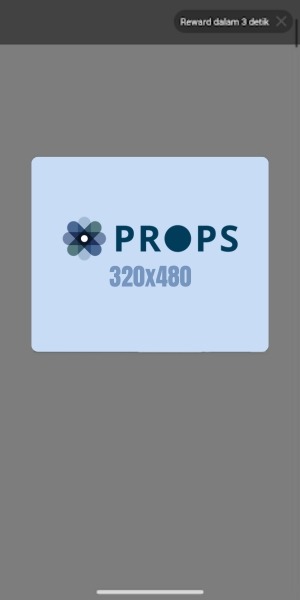
Image: ProPS Archives
Rewarded video is an ad in the form of a video that provides a reward to the user after it is watched to completion. Usually, the duration is around 15–30 seconds.
The most common examples are in game apps. Users watch videos to get:
- Additional coins
- Extra lives
- Unlock certain features
Below are the standard specifications commonly utilized for this format:
- Placement: Triggered by specific user actions (e.g., “Watch video for extra life”).
- Format: Full-Screen (Adaptive).
- Typical Resolution: Most creatives are delivered at 1920×1080 (Landscape) or 1080×1920 (Portrait) to ensure high-quality display across modern devices.
Why is Rewarded Video Still Effective?
Because users feel they are getting something. They do not feel “forced” to watch ads.
In terms of performance:
- High engagement
- High completion rate
- eCPM is usually higher compared to banners
This format is often one of the biggest contributors to revenue in apps, especially games and entertainment apps. However, the placement and frequency must be precise. If offered too often, it can actually reduce its exclusive value.
If you want to maximize revenue from rewarded ads without disrupting the user experience, ProPS can help manage placement strategies and optimization to be more effective.
2. Interstitial Ads
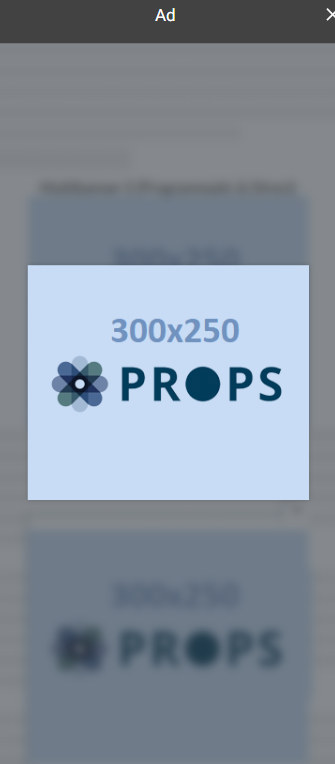
Image: ProPS Archives
Interstitial ads are full-screen ads that appear at transition moments, for example:
- After finishing a game level
- When changing pages
- After completing an activity
Because the display is fullscreen, user attention is automatically drawn to that ad.
Below are the standard specifications commonly utilized for this format:
- Format: Full-Screen (Adaptive).
- Typical Resolution: Common creative sizes include 320×480 (Portrait) and 480×320 (Landscape). Because they occupy the entire screen, they offer high visibility and engagement.
Why is it Used So Much?
Because:
- High visibility
- CTR is higher than banners
- Suitable for increasing quality impressions
However, this is also the most sensitive format. If it appears at the wrong time, users can feel annoyed.
The key is in the timing. Interstitials placed at natural moments (e.g., pauses between activities) are usually still comfortable for users.
ProPS can help publishers determine the best moments to display interstitials so that revenue rises without lowering user retention.
3. Display Banner Ads
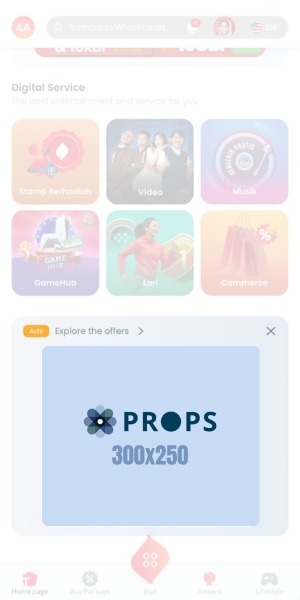
Image: ProPS Archives
Display banner ads are the most classic ad format. Their size is smaller and they usually appear at the top or bottom of the screen. Although it looks simple, banners remain the backbone of monetization for many apps with high traffic.
Below are the standard dimensions commonly utilized for this format:
- 320×50 (Standard Mobile Banner): The staple size for mobile, placed at the top or bottom.
- 300×50 (Mobile Banner): Slimmer profile for tighter layouts.
- 320×100 (Large Mobile Banner): More visual real estate for better performance.
- 300×250 (Medium Rectangle): Often used for “inline” ads within content to increase CTR.
Why are Banners Still Used?
Because:
- Stable
- Not too intrusive
- Suitable for apps with long usage duration
Indeed, banner eCPM is usually lower compared to rewarded or interstitial. But if the traffic is high and the placement is consistent, the total revenue can still be significant. It’s like renting out small advertising boards. Maybe it’s not expensive per unit, but if the quantity is large, the results are still felt.
Through demand optimization and the right floor price, ProPS helps improve banner performance so it doesn’t just become “space filler,” but is truly productive.
4. App Open Ads
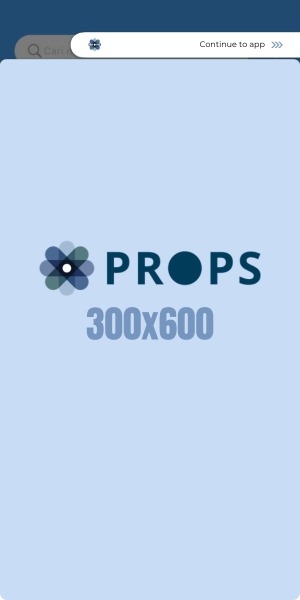
Image: ProPS Archives
App open ads are ads that appear when the user first opens the app. This format usually appears for a few seconds before the main content is displayed.
Below are the standard specifications commonly utilized for this format:
- Format: Full-Screen (Responsive).
- Typical Resolution: These ads are designed to be responsive. They typically use the same aspect ratios as other full-screen formats (such as 1080×1920 or 1920×1080) to ensure they fit the screen perfectly regardless of device orientation.
Why is This Format Potential?
Because:
- High visibility level
- Users are in a focus condition
- Suitable for increasing additional impressions
However, it is important to maintain duration so it is not too long. If it is too heavy or slow, users might immediately close the app.
This format is very effective if set with the right frequency cap strategy. ProPS can also help publishers manage app open ads to remain optimal without slowing down the user experience.
The Role of AdMob, Ad Manager, and AdX in App Monetization
In managing the ad formats above, publishers usually use several important platforms.
What is Google AdMob?
Google AdMob is designed specifically for mobile apps. This platform makes it easy for developers to display various ad formats such as rewarded, interstitial, banner, and app open.
Advantages:
- Easy integration
- Suitable for startups and beginner developers
- Supports mediation
Disadvantages:
- Access to premium demand is limited compared to AdX
- Less flexible for large-scale publishers
AdMob works by connecting your app to the Google ad network. The system is relatively automated. However, when traffic starts to become high, often publishers start wanting more control over the ad inventory.
What is Google Ad Manager?
Google Ad Manager functions as an ad server as well as an ad inventory manager.
Its role in revenue strategy:
- Setting ad priorities
- Managing direct deals
- Optimizing yield
If AdMob is like an autopilot system, Ad Manager is like an airplane cockpit — you can set strategies in detail. For publishers with high traffic, using Ad Manager can help increase efficiency and revenue transparency.
What is Google Ad Exchange (AdX)?
Google Ad Exchange is a programmatic ads marketplace that provides access to global premium advertisers.
Why is it important in app monetization?
- Higher bidding competition
- Potential for larger eCPM
- Access to global brand advertisers
Simple analogy: If previously you rented a kiosk in a general market, AdX is like opening access to an international mall with global brands. The advertisers that enter usually have bigger budgets.
How Big is the Impact of App Monetization Strategy for Publishers?
A mature app monetization strategy can:
- Increase eCPM by up to 20–50%
- Reduce empty fill rate
- Keep user experience good
- Increase ARPU (Average Revenue Per User)
Without a clear strategy, an app will only rely on one source of demand and lose revenue potential. App monetization is not just about installing ads, but about how to manage inventory, demand, formats, and user experience in a balanced way.
If analogized, this is like managing a restaurant: it’s not just about having tables and chairs, but how to manage the menu, prices, customers, and promotions so the business runs maximally.
Why Do Many Publishers Need a Monetization Partner?
Managing AdMob, Ad Manager, and AdX is not just about installing ad code. There are many technical factors such as:
- Floor price optimization
- Demand channel setup
- Daily performance monitoring
- Revenue data analysis
Small mistakes can have a big impact on revenue. This is where partners like ProPS play a role. We help publishers optimize app monetization comprehensively, from setup to long-term strategy. The approach is not just about increasing the number of ads, but increasing the quality and value of every impression.
Conclusion
App monetization is the main strategy in building long-term app revenue. By understanding how rewarded video, interstitial, banner, and app open ads work, and maximizing the roles of AdMob, Ad Manager, and AdX, publishers can unlock much greater revenue potential.
Ultimately, the success of app monetization is not just about high traffic, but how that traffic is converted into revenue smartly, in a structured, and sustainable way.
FAQ
- What is app monetization? A way to make money from apps through ads, purchases, or subscriptions.
- Which ad format is most profitable? Rewarded Video and Interstitial usually have high eCPM, but the best format combination depends on the app.
- What is the difference between AdMob, Ad Manager, and AdX? AdMob for quick setup, Ad Manager for more detailed control, AdX for access to global premium demand.
- Does app monetization disturb users? It can if not managed. The right strategy keeps the experience comfortable.
- How to increase app revenue? Optimize ad formats, use the right platforms, and analyze eCPM performance and fill rate regularly.