



Points of the Article
- Publisher Provided Signals (PPS) is the infrastructure that replaces what third-party cookies carried, and it’s available now. Rather than waiting for a cookie replacement, PPS gives publishers a way to label their own audience using first-party behavioral and contextual data, map it to IAB taxonomy standards, and pass it directly into every programmatic bid request. The result: advertisers bid with more confidence, CPMs rise, and the publisher controls the data relationship.
- The quality of your PPS is determined by the quality of your content structure. PPS maps your content categories to IAB Audience Taxonomy 1.1 and IAB Content Taxonomy 2.2. Vague content categories produce vague signals that advertisers can’t bid on confidently. Clean, specific, well-organized content taxonomy produces precise signals that command premium rates. The same content structure that benefits SEO and AI citation also determines the ceiling of your PPS revenue.
- PPS and PPIDs are different tools for different situations, and confusing them leads to wrong implementation. PPIDs identify individual users across sessions and require login data. PPS classifies audience segments without individual identification and works without a registration wall. Publishers need to understand which tool fits their current data infrastructure before implementing either, and for most publishers without strong login data, PPS is the more immediately accessible revenue lever.
Publisher Provided Signals are no longer a feature worth evaluating. They are the infrastructure every ad-supported publisher needs right now, because the alternative is watching your CPMs quietly erode while you wait for a cookie replacement that isn’t coming.
The third-party cookie didn’t die dramatically. It’s been leaving slowly for years, browser by browser, regulation by regulation. Safari blocked third-party cookies in 2017. Firefox followed. Google delayed its own Chrome deprecation repeatedly, but the direction was never in doubt.
For publishers, the practical impact has been building just as slowly. Advertisers who once relied on cross-site tracking to identify and target valuable users are now reaching your pages with less information. Less information means less confidence in their bids. Less confidence means lower CPMs.
Publisher Provided Signals (PPS) is a feature in Google Ad Manager that allows publishers to leverage their own first-party data and contextual information to enhance programmatic ad monetization. PPS enables publishers to categorize their audience and contextual data using standardized industry segments aligned with IAB taxonomies for audiences and content.
Put simply: instead of waiting for a third party to tell advertisers who’s on your site, you tell them yourself. That shift, from passive inventory to active, labeled audience, is where the CPM premium lives.
What PPS Actually Does (and What It Doesn’t)
Before getting into implementation, it’s worth being precise about what Publisher Provided Signals are, because the terminology in this space gets confused quickly.
PPS is a way for publishers to classify their first-party user data in a way that makes it easier and more secure to share with third-party buying partners. Publishers can segment their first-party data into contextually relevant segments such as age, demographics, and purchase intent, and share it securely and at scale with programmatic buyers.
PPS is not the same as PPIDs (Publisher Provided Identifiers). A PPID is a unique identifier assigned to individual users by publishers within their own ecosystems. The focus of PPIDs is on identifying and tracking users across devices while protecting their privacy. PPS, on the other hand, is about classifying and sharing audience data at the segment level, not the individual user level.
This distinction matters practically. PPIDs require users to be logged in or identifiable, typically through a registration wall or subscription. PPS works without individual identification. You observe behavioral patterns at the session level, map them to IAB taxonomy segments, and pass those segments into the auction. No personal data is shared. No cross-site tracking is involved.
PPS aren’t used to develop cross-publisher user profiles. If a publisher chooses to pass PPS, they’re only scoped to the publisher that provided them, meaning user profiles produced using PPS aren’t joined between publishers or added to a profile produced using Google user identifiers.
This is what makes PPS both privacy-compliant and genuinely valuable: the signal is specific enough to be useful to advertisers, but scoped tightly enough to protect users.
| Feature | Publisher Provided Identifier (PPID) | Publisher Provided Signal (PPS) |
| Primary Purpose | User Identification: Identifies a specific, unique user across your properties for frequency capping and delivery limits. | Audience/Context Grouping: Describes content or audience segments (e.g., sports enthusiasts) using standardized categories. |
| Nature of Data | An anonymous, encrypted alpha-numeric ID (e.g., 12DJD92J). | Descriptive data or encrypted data payloads (often following IAB taxonomies). |
| Privacy / Targeting | Allows for highly precise 1:1 ad personalization without sharing Personally Identifiable Information (PII). | Allows advertisers to target specific cohorts without needing to know a user’s individual identity. |
| Main Benefit | Ensures a single user isn’t repeatedly served the same ad across different devices or sessions (frequency capping). | Makes first-party publisher data readable and discoverable for programmatic buyers in a cookieless environment. |
| Prerequisite | Required: User Login / Strong First-Party ID | Required: Structured Content / Taxonomy Mapping |
The Two Types of PPS, and Why Both Matter
PPS can include behavioral and interest-based data mapped to IAB Audience Taxonomy 1.1, and contextual data mapped to IAB Content Taxonomy 2.2, as well as Google-defined structured signals.
Audience Taxonomy PPS maps to who your users are, their interests, demographics, and behavioral patterns. A user who consistently reads your personal finance content gets mapped to IAB Audience segments like “Financial Planning & Management” or “Personal Investing.” This signal tells advertisers something about the person consuming the content.
Content Taxonomy PPS maps to what your content is about, the topic, format, and category of the specific page. The same financial article gets mapped to IAB Content segments like “Personal Finance” or “Investing.” This tells advertisers something about the context surrounding the ad.
Both signals work together in the auction. Audience signals drive premium bids from advertisers who want to reach specific people. Content signals drive premium bids from advertisers who want brand-safe, relevant environments. Publishers with clean implementation of both consistently outperform those using only one.
The Revenue Case: Why Labeled Inventory Commands a Premium
The core revenue argument for PPS is straightforward: labeled inventory sells for more than unlabeled inventory.
By providing richer data about their audience and content, publishers can make their ad inventory more attractive to potential buyers, potentially leading to higher bids.
When an advertiser bids on an unlabeled impression, they’re making assumptions. The impression could be a high-value user or a low-value one, they can’t tell. To account for that uncertainty, they bid conservatively. When a publisher passes a PPS signal that maps a user to “High Household Income > $100K” or “In-Market: New Vehicle Purchase,” the advertiser’s uncertainty drops significantly. They bid with more confidence, and higher confidence translates directly to higher CPMs.
TelevisaUnivision, evaluating PPS in beta alongside Permutive, recognized that activating first-party data in the auction could improve programmatic ad performance and potentially unlock new revenue growth. First-party data has been historically restricted to direct deals because each publisher’s audience cohorts are unique to their business.
That last point is important for publishers who run direct deals: PPS brings first-party audience value into the programmatic auction at scale, not just into manually negotiated deals. The same audience intelligence that once required a sales conversation can now flow automatically into every programmatic bid request.
The Technical Foundation: Why Content Structure Determines PPS Quality
Here’s the part most publishers underestimate: the quality of your Publisher Provided Signals is a direct function of your content’s organizational structure.
Publishers are expected to map their first-party data to the standardized industry segments that Google Ad Manager supports. That mapping process depends entirely on having content that is categorized clearly and consistently enough to translate into IAB taxonomy terms.
If your article sections are vague, “Lifestyle,” “News,” “Features”, your PPS will be vague. If your content is structured around specific, meaningful categories, “Automotive,” “Personal Finance,” “Travel – Southeast Asia,” “Health & Wellness”, your PPS will be specific and valuable.
This is why the relationship between editorial taxonomy, SEO structure, and ad monetization is not coincidental. A publisher with clean, well-structured content categories can implement PPS quickly and accurately. A publisher with flat, inconsistent content structure will produce noisy PPS that advertisers don’t know how to bid against.
The practical implication: before implementing PPS, audit your content categories. Align them to IAB Audience Taxonomy 1.1 and IAB Content Taxonomy 2.2. This work pays dividends across SEO, AI citation, and ad revenue simultaneously, it’s the same content structure that helps Google index you, helps AI cite you, and now helps advertisers bid on your audience with confidence.
How to Start: A Practical Implementation Path
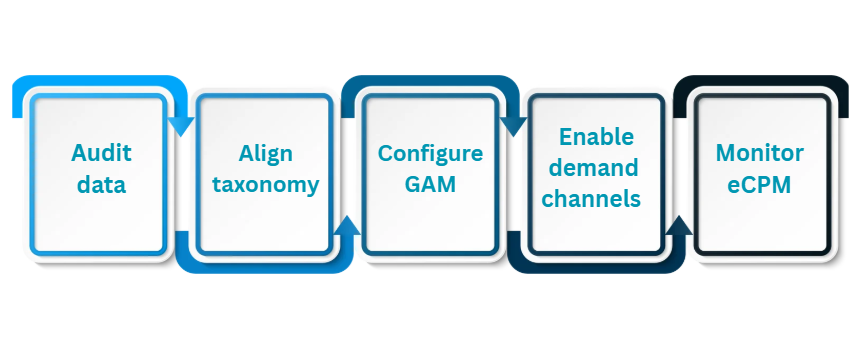
Publisher Provided Signals is enabled by default for all Ad Manager 360 publishers. You control sharing of the signals through your demand channel settings, navigate to Delivery, then Demand channel settings, then Publisher data sharing to enable signals for specific demand channels.
For publishers not on GAM 360, PPS implementation requires working through your existing GAM setup or a monetization partner. The steps are the same, the access level differs.
Step 1
Audit your first-party data. What do you actually know about your users? Login data, behavioral patterns, content consumption history, device type. The more you know, the richer your PPS can be.
Step 2
Align your content taxonomy to IAB standards. Map your existing categories to IAB Audience Taxonomy 1.1 (for audience signals) and IAB Content Taxonomy 2.2 (for contextual signals). This is the most time-intensive step, but it’s foundational. Without it, everything downstream is compromised.
Step 3
Configure PPS in GAM. Map your audience segments and key-value data to the relevant IAB taxonomy IDs. The publisher standardizes content and audience signals into an applicable PPS-supported taxonomy, then sends an ad request to Ad Manager with content and audience signals sent as taxonomy category IDs.
Step 4
Enable sharing with demand channels. PPS can be sent to Google demand including Open Auction, Private Auction, Preferred Deals, and Programmatic Guaranteed, as well as Authorized Buyers, Open Bidding, and SDK Bidding. Enabling across all channels maximizes your CPM ceiling.
Step 5
Monitor eCPMs by segment. Track the performance difference between segmented and unsegmented traffic. This comparison will tell you which audience segments are generating the most premium and where to invest further in content and data development.
The Indonesia Opportunity
For Indonesian publishers, PPS carries a specific advantage that goes beyond the general revenue case.
Local audience data, Indonesian consumer behavior, regional interest patterns, purchasing intent specific to the Indonesian market, is genuinely scarce in the programmatic ecosystem. Global advertisers targeting Indonesian consumers often have limited data to work with. A local publisher that can pass precise, IAB-mapped PPS about Indonesian audiences is offering something that demand-side platforms simply cannot source elsewhere.
The same principle applies to hyper-local content publishers, those covering specific cities, provinces, or niche verticals within Indonesia. That local specificity, when properly structured and passed as PPS, is a premium signal that commands premium rates. No algorithm at a global DSP can replicate what you know about your own Indonesian audience.
The Honest Picture
Publisher Provided Signals is not a switch you flip and watch CPMs improve overnight. It is infrastructure and infrastructure requires upfront work before it generates returns.
The coordination between editorial, tech, and ad ops teams that PPS requires is real. The taxonomy alignment work is not trivial. But for publishers who do it properly, the revenue case is straightforward: labeled inventory in a cookieless world sells for significantly more than unlabeled inventory. And the publishers who build that labeling capability now will be structurally advantaged as the ecosystem continues moving away from third-party identifiers.
The cookie is leaving. PPS is the infrastructure that replaces what it carried.
ProPS works with publishers across Indonesia to implement Publisher Provided Signals strategy, from content taxonomy alignment to GAM configuration and ongoing optimization. If your CPMs are stagnating and you’re ready to activate your first-party data, we’d like to talk.
FAQ
Q: Do I need GAM 360 to use Publisher Provided Signals?
A: Publisher Provided Signals is enabled by default for GAM 360 publishers. For publishers on the standard (free) version of Google Ad Manager, some PPS features may be limited or unavailable. However, working with a Google Certified Publishing Partner like ProPS can give smaller publishers access to PPS implementation support and, in some cases, the technical infrastructure to activate PPS even without a full GAM 360 account. If you’re unsure which GAM version you’re on and what PPS access it includes, that’s the right first question to answer before starting implementatio
Q: What’s the difference between PPS and PPIDs? Which one should I implement?
A: PPIDs (Publisher Provided Identifiers) assign a unique, anonymized ID to individual users, typically requiring those users to log in or register. PPIDs are powerful for publishers with strong login data because they enable frequency capping and cross-device audience building within your own ecosystem. PPS works at the segment level rather than the individual level, no login required. For publishers without a registration wall or strong login data, PPS is the more accessible starting point. The two are complementary and can be used together, but PPS delivers value faster for publishers who don’t yet have the data infrastructure to support PPIDs at scale.
Q: How much can PPS actually improve CPMs?
A: The honest answer is: it depends on how well your content is structured and how valuable your audience segments are to advertisers. The CPM lift from PPS varies significantly by vertical, audience quality, and the precision of your taxonomy mapping. Publishers in high-value verticals; finance, automotive, health, and travel, with clean content structure and precise IAB taxonomy mapping tend to see the most significant uplift. A publisher passing a generic “News” signal will see minimal impact. A publisher passing “Personal Finance > Investing > Mutual Funds” to a user who has read three related articles in a session will see meaningful CPM improvement. The data work upfront is what determines the revenue outcome downstream.
Q: Can PPS work for app publishers, not just web publishers?
A: Yes. For apps, OTT/CTV environments, and situations where contextual signals are limited, PPS can provide valuable data about the content being consumed. App publishers who have behavioral data about their users, which features they use, what content they engage with, how they navigate the app, can map that data to IAB taxonomy segments and pass it as PPS in mobile ad requests. The implementation differs technically from web PPS, but the underlying principle is the same: label your inventory with first-party signals that tell advertisers who they’re reaching.
Q: How do I know if my PPS implementation is working correctly?
A: Three signals to watch. First, check your Google Ad Manager reporting for eCPM differences between segmented and unsegmented traffic. A meaningful gap confirms the signals are being used by buyers. Second, verify in GAM’s demand channel settings that PPS sharing is enabled for the channels you want to reach. Third, use Google’s Publisher Provided Signals reporting within GAM to see which taxonomy segments are generating bid activity and which are being ignored. Ignored segments usually indicate either a taxonomy mapping problem or a segment that advertisers simply don’t value, both of which are worth investigating and fixing.
Sources
- Google Ad Manager Help — About Publisher Provided Signals (Beta) https://support.google.com/admanager/answer/12451124
- Google Ad Manager Help — Share Publisher Provided Signals at Time of Ad Request https://support.google.com/admanager/answer/15287325
- PPC Land — Understanding Publisher Provided Signals in Google Ad Manager (May 2024) https://ppc.land/understanding-publisher-provided-signals-in-google-ad-manager/
- Publift — What Are Google’s Publisher Provided Identifiers (PPIDs)? (April 2026) https://www.publift.com/blog/google-ppid
- Google Ad Manager Success Stories — TelevisaUnivision and Permutive Use Google’s Publisher Provided Signals https://admanager.google.com/home/success-stories/televisaunivision-and-permutive-use-googles-publisher-provided-signals-to-scale-first-party-data/
- Google Ad Manager Success Stories — Future Publishing’s Privacy-Led Data Approach https://admanager.google.com/home/success-stories/future-publishings-privacy-led-data-approach-to-deliver-engaging-advertising/
- Google Developers — Improve Ad Campaigns with PPS (IMA SDK) https://developers.google.com/interactive-media-ads/docs/sdks/android/client-side/pps