



Points of this article..
1. To write content that AI actually cites, you must understand that machines don’t read, they extract. AI systems use RAG architecture to break articles into standalone passages. This means a 500-word piece structured for extraction will consistently outperform a disorganized 3,000-word article. Every paragraph you write needs to make sense as a standalone unit.
2. Specificity is the single biggest lever for AI citation. Vague claims get ignored. Specific numbers with attributed sources get cited. Content with verifiable data earns 30–40% more AI visibility than qualitative content. Adding a cited statistic every 150–200 words is the clearest structural change most content teams can make immediately.
3. Your website is only half the battle, AI pulls from everywhere. 48% of AI citations come from community platforms, not owned sites. LinkedIn articles, expert commentary in industry publications, and original research that others cite are direct inputs into your AI visibility. GEO content strategy is a distribution strategy, not just a writing strategy.
Writing for AI citation is not the same as writing for Google. The rules have changed, and most content creators are still playing the old game.
Most content creators learned to write for search engines by optimizing for keywords, building backlinks, and covering topics broadly. That approach still matters, but it’s no longer enough on its own.
In the SEO era, the goal was to rank. In the GEO era, the goal is to be chosen. Those are not the same game.
AI-referred sessions jumped 527% between January and May 2025. AI platforms generated 1.13 billion referral visits in June 2025 alone. The audience is real, it’s growing fast, and it converts well. Ahrefs found AI-referred traffic converts at 2.4 times the rate of organic search.
But here’s the catch: citation patterns show extreme concentration, the top 20% of cited domains capture 80% of all AI references. The window is open, but it’s not open equally for everyone. The content creators who understand how AI systems actually select and extract information are the ones building toward that top 20%.
This article covers exactly how to write content that AI cites. Not theory, practical, actionable changes you can make to existing and new content starting today.
Why AI Reads Content Differently Than Google Does
Google ranks pages. AI cites statements. That single difference changes everything about how you should write.
A 2,000-word article isn’t retrieved as a whole. Only the passages that read like complete, citable answers get pulled. Write every paragraph as if it could stand alone.
This is the core shift. Think of AI systems like a picky reader using a highlighter. Through an architecture called RAG (Retrieval Augmented Generation), AI doesn’t digest your whole article. Instead, it ‘scans’ and ‘chops’ your content into small, standalone blocks. If a block provides a perfect, direct answer, it gets highlighted (cited). If it’s just fluff, it gets skipped. It’s that simple.
The implication is significant. A well-written 500-word article structured around clear, standalone answers will often get cited more than a disorganized 3,000-word piece covering the same topic. Length matters less than structure. A 500-word piece, perfectly structured with direct answers, will be cited more often than a disorganised 3,000-word article. Focus on information density, every paragraph should provide extractable information.
The Five Writing Habits That Get Content Cited
1. Answer First, Explain Second
Start with the answer. Give a direct, declarative statement. Add supporting detail. Offer brief clarification, context, or an example. Reinforce the key point. End by paraphrasing the main idea using different words.
Stop the ‘tease.’ We’ve been trained to build suspense in long-form articles, saving the ‘gold’ for the conclusion. AI doesn’t have that kind of patience. If your opening 60 words don’t give the answer immediately, you’ve already lost the citation. Answer first, explain later. It’s a discipline shift, but it’s non-negotiable.
Structure content with direct answers in the first 40–60 words. If someone asks “what is GEO?” your opening sentence should answer that question completely, not tease it, not introduce it, not contextualize it first. Answer it, then explain.
2. Use Specific Numbers, Not Vague Claims
Avoid vague language. Use specific numbers, timeframes, and attributions. “According to Gartner’s 2024 research, traditional search volume will decline 25% by 2026” beats “Search is declining.”
AI systems are built to favor verifiable claims. A specific statistic with an attributed source gives the AI something concrete to cite. A vague observation gives it nothing. Content with verifiable data earns roughly 30–40% more visibility in LLM-generated answers than purely qualitative content.
Maintain fact density with statistics every 150–200 words, and cite authoritative sources throughout. This isn’t just good practice, it’s the signal that tells AI systems your content is worth pulling from.
3. Structure With Questions as Headings
AI search queries are overwhelmingly question-based: “What is…”, “How do I…”, “Why does…”. Structure your content with headings that match these patterns: H2: “What Is [Topic]?” followed by a clear 2–3 sentence definition. H2: “How Does [Topic] Work?” followed by a step-by-step explanation.
When your heading matches the question a user is asking AI, and your content directly under that heading answers it, you’ve created exactly the kind of extractable chunk AI systems are looking for. Pages with explicit headings and clear structure are 2.8 times more likely to be cited.
4. Add FAQ Sections – They Work Differently Now
FAQ sections used to feel like filler. In a GEO context, they’re one of the highest-leverage elements in your content.
Add FAQs two ways: visible ones for your readers, and schema markup for search engines. The visible content is what gets quoted, schema just makes it easier to find and understand.
The most impactful schemas for AI citation include FAQPage, question-answer pairs that AI can directly surface and Article, which establishes author, date, and headline, creating content provenance. These aren’t technical extras. They’re signals that tell AI systems exactly what your content is about and who created it.
5. Keep Paragraphs Short and Self-Contained
Aim for short, structured paragraphs, about 60–100 words each. Sentences should be no longer than 15–20 words each.
Long, winding paragraphs are hard for AI systems to extract cleanly. A paragraph that makes one point clearly, supports it with a fact, and closes the thought, that’s a citable chunk. Dense paragraphs that build across multiple ideas get skipped.
What You Publish Is Only Part of the Picture
Here’s something most content creation guides don’t address: your own website is not the only place that matters for AI citation.
LinkedIn was among the top-cited sources by major LLMs in late 2025. Long-form LinkedIn articles and thought leadership posts are indexed and cited by AI platforms, especially for professional queries.
Original research is GEO gold. Benchmark studies, industry surveys, and data analyses give other publications a reason to link to you and give AI engines a reason to cite you as the primary source. If you publish something no one else has, AI engines have no choice but to cite you.
48% of AI citations come from community platforms and only 44% from owned sites. A GEO strategy limited to your website leaves you invisible for nearly half of potential citations.
This reframes content creation significantly. Writing a great article on your own site is necessary but not sufficient. Getting quoted in an industry publication, contributing expert commentary, or having your research cited by others, these are now direct inputs into your AI visibility.
Keep Your Content Fresh
AI systems favor recent sources. 79% of AI bots mainly index content from the past two years, and 65% focus on content published in the current year.
This means old content that once ranked well can quietly lose AI citations to newer, updated competitors, even if the underlying information is still accurate. Establish a review cycle. Use a 3–6 month cycle for checking priority pages. Add a changelog or revision history note when you update key facts. Small edits like adding new FAQs from support chats can help keep your pages active in AI indexes.
A Simple Pre-Publish Checklist
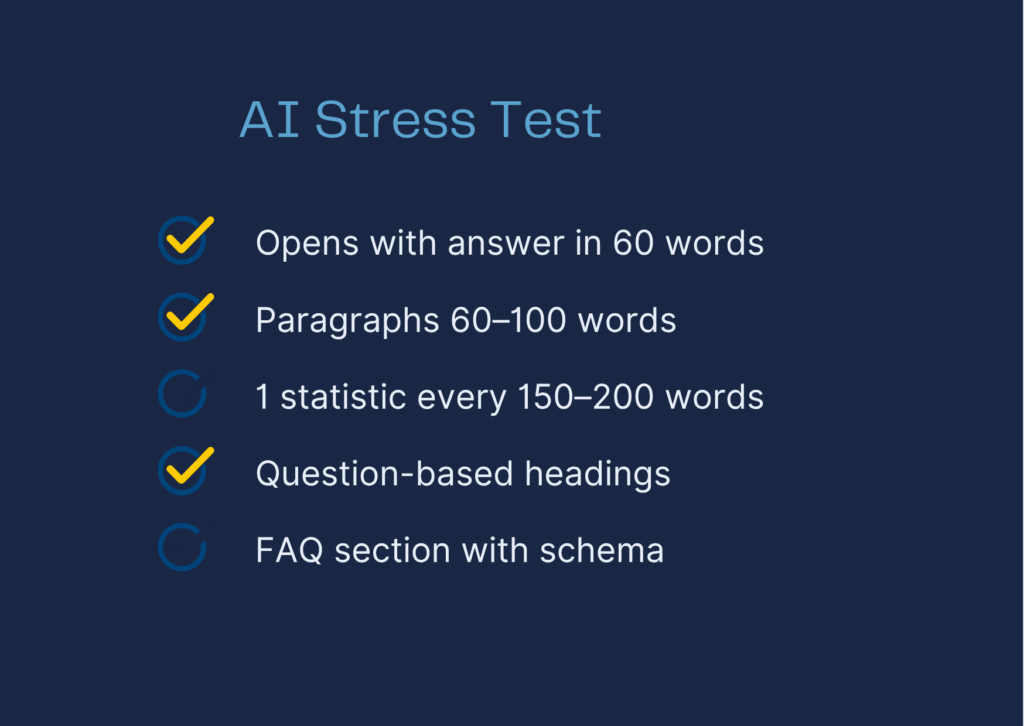
Before you hit ‘Publish,’ put your content through the ‘AI Stress Test’:
- Does the opening paragraph answer the main question in under 60 words?
- Are paragraphs 60–100 words with sentences under 20 words?
- Is there at least one verifiable statistic with an attributed source every 150–200 words?
- Do the headings match the questions users would ask?
- Is there an FAQ section with schema markup?
- Does every paragraph make sense if read in isolation?
The Discipline Shift Worth Making
Writing for AI citation requires a real discipline shift. Content that works for GEO tends to be more structured, more specific, and more direct than what most content teams are used to producing.
Google ranks pages. AI cites statements. That single difference changes everything about how you write, structure, and distribute content.
The good news is that content written well for GEO tends to perform better in traditional SEO too. Content structured for GEO with clear headings, direct answers, and cited facts, often performs better in traditional SEO as well, because it aligns with Google’s helpful content guidelines.
It’s not either/or. The discipline of writing for AI citation makes content more useful for human reader, clearer, more specific, and easier to extract value from quickly.
In the next piece in this series, we’ll look at GEO from an Indonesia-specific angle, why the adoption gap here represents one of the clearest early-mover opportunities in Southeast Asia.
In Southeast Asia, and specifically Indonesia, the ‘trust gap’ in digital content is high. AI will favor brands that provide verifiable local data over generic global claims. In the next piece, we’ll dive into why this is a goldmine for local publishers.
Writing for AI isn’t about gaming a new algorithm; it’s about being undeniably useful. If your content is structured to be cited by a machine, it will inevitably be more valuable for the human being on the other side of the screen.
ProPS helps publishers and brands build content infrastructure that performs in an AI-first search environment. If you’re thinking through your GEO content strategy, we’d like to talk.
FAQ
Q: Do I need to rewrite all my existing content for GEO?
A: Not all of it, but a targeted audit is worth doing. Start by identifying your top 10 to 15 articles that already have good organic traffic. These are the most likely candidates to earn AI citations with some restructuring. Add FAQ sections, break up dense paragraphs, move the main answer to the opening, and add schema markup where it’s missing. You don’t need to start from scratch, you need to restructure what’s already working.
Q: How long should paragraphs be for GEO-optimized content?
A: 60 to 100 words per paragraph is the practical target. Each paragraph should cover one idea, support it with a specific fact or example, and close the thought. Sentences should stay under 20 words where possible. This isn’t just for AI readability, shorter, clearer paragraphs improve human readability too, which tends to reduce bounce rate and increase time on page.
Q: Does schema markup actually make a difference for AI citation?
A: Yes, but it’s one factor among several, not a magic fix. FAQPage schema is the highest-impact implementation for most content teams because it creates structured question-answer pairs that AI systems can directly surface. Article schema establishes authorship and publication date, which signals credibility and freshness. If you implement nothing else, start with FAQPage schema on your most important content.
Q: My content is already ranking well in Google. Do I still need to change my writing approach for GEO?
A: Probably yes, but the gap may be smaller than you think. Content that ranks in the top 5 Google results appears in Google AI Overviews approximately 74% of the time, so strong SEO is still a meaningful GEO foundation. What GEO adds is citation-readiness: answer-first structure, fact density, FAQ sections, and modular paragraphs. These changes tend to improve traditional SEO performance too, so the investment works in both directions.
Q: How do I know if my content is actually being cited by AI?
A: Start manually: run 10 to 15 queries your target audience would ask across ChatGPT, Google AI Overviews, Gemini, and Perplexity. Note where your content appears and where it doesn’t. For more systematic tracking, tools like Semrush and Frase are developing AI citation monitoring features. In Google Analytics 4, watch for referral traffic from chatgpt.com, perplexity.ai, and similar domains. These numbers are still small for most sites, but they’re growing fast and the conversion rates tend to be significantly higher than standard organic traffic.
Sources:
- Discovered Labs — GEO Content Strategy: How to Write for AI Search (January 2026)
- Frase.io — Mastering AI Citations: The Ultimate GEO Playbook (March 2026)
- Foglift — AI Content Optimization: How to Write Content That AI Cites (March 2026)
- ToTheWeb — GEO Checklist: Mastering Content Creation for AI Search Engines (April 2026)
- RedefineROI — Generative Engine Optimization: The Complete Guide for 2026
- The VC Corner — GEO & AEO: How to Get Cited by AI Search (February 2026)
- Medium / Nidm SEO — The GEO Blueprint (January 2026)
- Frase.io — What is Generative Engine Optimization? (2026)
- SEO Tuners — GEO Best Practices 2026 (March 2026)
- Incremys — GEO Content Strategy 2026 (April 2026)