



Points of this article..
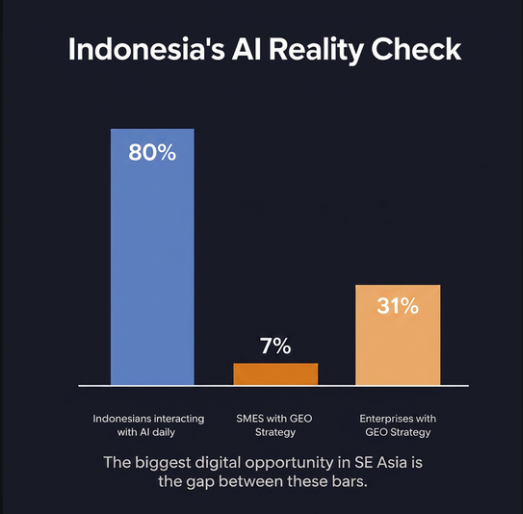
- Indonesia’s GEO Gap presents a unique paradox in the digital landscape. We currently have one of the highest AI adoption rates in the world, yet almost no one is optimizing for it. This Indonesia’s GEO Gap isn’t just a statistic; it’s the single biggest ‘early-mover’ advantage in Southeast Asia right now. While 80% of Indonesians interact with AI daily, only 7% of SMEs and 31% of enterprises have implemented a formal strategy. Considering AI traffic converts at 4.4 times higher rates than standard search, the businesses moving now are building a massive competitive advantage while others remain unaware.
- The performance gap between GEO and non-GEO businesses in Indonesia is already compounding. Indonesian businesses with a formal GEO strategy report 3.4 times more monthly AI citations than those without one. AI search referral traffic from Southeast Asia is growing 190–210% year-over-year, the fastest globally. First-mover advantage in GEO is not theoretical; it is already measurable in citation share.
- Bahasa Indonesia content and local data are structural GEO advantages that global competitors cannot replicate. Google launched AI Mode in Bahasa Indonesia in September 2025, giving local-language content a direct path into AI-generated answers for 229 million users. Indonesian market data is scarce in global AI training sets, making original local research a near-guaranteed citation source. These are moats that English-only competitors simply cannot build.
Indonesia has 230 million internet users, one of the world’s highest AI adoption rates, and a digital economy closing in on $130 billion. It also has one of the largest GEO adoption gaps of any major market on the planet. That combination is not a problem, it’s an opportunity, and it’s sitting largely untouched.
Here’s the number that should stop every marketer in Indonesia cold
Only 7% of Indonesian SMEs and 31% of enterprises have implemented any GEO optimization, despite AI traffic converting at 4.4 times higher rates than standard digital traffic.
Let those numbers sink in for a moment. While 80% of Indonesians are already chatting with AI daily, only a tiny fraction of businesses are actually showing up in those conversations. We are currently in a massive visibility vacuum.
The gap between how Indonesians are using AI and how Indonesian businesses are responding to that usage is striking. And for brands, publishers, and content teams who move now, it represents a first-mover window that doesn’t come around often.
The Indonesian Digital Landscape Has Changed Faster Than Most Teams Realize
Indonesia’s digital transformation story is well known. What’s less understood is how quickly the search and discovery behavior of Indonesian consumers has shifted, and what that means for visibility.
More than a third of Indonesians now use ChatGPT monthly, making it one of the country’s most visited platforms. ChatGPT ranks as the fourth most visited website in Indonesia according to Similarweb, accounting for 80.6% of AI web traffic referrals.
That’s not a niche technology product anymore. That’s mainstream consumer behavior, and it’s shaping how Indonesians research products, evaluate brands, and make purchase decisions.
On September 9, 2025, Google launched AI Mode in Bahasa Indonesia, powered by Gemini 2.5. For the first time, all 229 million Indonesian internet users could receive comprehensive, conversational AI-generated answers in their native language.
That launch changed the game for local content. Bahasa Indonesia content that is structured for AI citation now has a direct path into the answers that hundreds of millions of Indonesian users are receiving every day.
And the traffic impact is already measurable. 65% of Indonesian Google searches now end without a click to any website. Organic CTR for informational queries dropped from 1.41% to 0.64% (a 54.6% decline) with AI Overviews.
The GEO Performance Gap: Why AI Citations are Compounding in Indonesia
Here’s what makes the current moment critical: the businesses that have started GEO are already pulling ahead and the gap is widening.
Only 23% of Indonesian businesses have a formal GEO strategy, yet those businesses report 3.4 times more monthly AI citations than their non-GEO peers. The performance gap is compounding.
Compounding is the key word. AI citation is not linear, once an AI system starts treating a domain as a trusted source, it tends to continue citing it. AI search referral traffic from Southeast Asia is growing 190 to 210% year-over-year, the fastest globally, driven by mobile-first adoption.
The brands building GEO presence now are accumulating an advantage that becomes harder to close with every passing month.
Adding citations and statistics to a page can lift AI engine visibility by up to 115% for lower-ranked pages, and adding statistics alone improves visibility by 41%. These are not marginal improvements, they’re the kind of structural shifts that separate brands that show up in AI answers from those that don’t exist in that conversation at all.
Why Indonesia Is a Particularly High-Value GEO Market
Not every market offers the same GEO opportunity. Indonesia’s specific combination of factors makes it unusually valuable, and unusually underserved.
Scale that most markets can’t match. Indonesia has 229 million internet users across an archipelago of 17,000 islands, with a digital economy closing in on $130 billion. With a median age of just 30.4, millennials and Gen Z are the dominant user groups, and they’ve grown up with mobile-first digital services as default infrastructure. This is an audience that adopts new discovery behaviors fast.
AI adoption without GEO optimization. 92% of Indonesian knowledge workers report using generative AI, and 92% of business leaders see AI as critical for competitiveness. But usage and optimization are two completely different things. Indonesian professionals are using AI daily, but the content they encounter in those AI answers is rarely being shaped by local brands with deliberate GEO strategy.
Bahasa Indonesia as a structural moat. Here’s the part everyone is missing: Bahasa Indonesia is your secret weapon. Global competitors are fighting over English-language citations in a crowded room. But in our local language? The field is wide open. By building structured content in Bahasa, you’re building a wall that global players can’t easily climb.
A brand that builds authoritative, well-structured Bahasa Indonesia content for AI citation is not just competing locally, it is building a moat that English-language competitors fundamentally cannot replicate. Local language depth is a GEO advantage that scales.
Local data has disproportionate AI value. AI systems favor verifiable, specific information. Indonesian market data, local consumer research, regional pricing, industry benchmarks specific to the Indonesian market is genuinely scarce in the AI training landscape. A brand that publishes original Indonesian market data becomes a primary source by default. There’s simply less competition for that citation.
What This Means Practically for Indonesian Brands and Publishers
The strategic implication is straightforward, even if the execution takes discipline.
Indonesian brands that are already doing reasonable SEO have the foundation they need. The additional layer required for GEO is not a complete rebuild, it’s a structural shift in how content is written and how data is used.
Specifically:
Prioritize Bahasa Indonesia content for AI citation. Given Google’s launch of AI Mode in Bahasa Indonesia, local-language content structured for AI extraction now has a direct path into the answers millions of Indonesian users receive daily. This is not a future opportunity, it’s available right now.
Treat original local data as a core content asset. Indonesian market benchmarks, consumer surveys, regional pricing data, and industry-specific research are underrepresented in AI training data. Publishing this kind of content makes citation almost inevitable, because there is no alternative source.
Move before the window closes. The 7% SME adoption figure will not stay that low for long. 75% of all search queries in Indonesia are projected to start with AI tools; ChatGPT, Gemini, Perplexity, by the end of 2026. The brands building AI visibility now are establishing a position that compounds. The ones who wait will face a market where early movers have already become the default cited sources.
The Honest Picture
Indonesia’s GEO gap is real, but it won’t stay this wide indefinitely. The agencies building GEO frameworks for the Indonesian market are doing so now, and enterprise adoption is moving faster than SME adoption.
The window is open. The data on what happens when businesses actually implement GEO 3.4 times more AI citations, 4.4 times higher conversion from AI-referred traffic, is clear enough to act on.
For Indonesian publishers and brands operating in the digital advertising ecosystem, this is the moment that will separate those who are findable in the AI-first search environment from those who are effectively invisible in it. The infrastructure for that shift already exists. The question is whether the will to build on it does too.
The next piece in this series moves from strategy to execution on the technical GEO side: schema markup, structured data, and the specific tools Indonesian content teams can use to start building AI visibility today.
ProPS is a Google Certified Publishing Partner working with publishers and brands across Indonesia to build content and monetization infrastructure for the AI-first search environment. If you’re thinking through your GEO strategy for the Indonesian market, we’d like to talk. Don’t wait for the window to close. Contact ProPS today for a 30-minute AI Visibility Audit of your domain.
FAQ
Q: Why is GEO adoption so low in Indonesia if AI usage is so high?
A: The gap exists because most digital marketing teams in Indonesia, and globally learned to optimize for Google Search, not for AI citation. Those are different skills, different content structures, and different measurement frameworks. GEO as a discipline only became mainstream in 2024–2025, and awareness is still catching up to the actual shift in user behavior. The good news for Indonesian brands is that the awareness gap is the opportunity: those who understand GEO now are building positions before the market catches up.
Q: Does GEO work differently in Bahasa Indonesia than in English?
A: The core principles are the same; answer-first structure, specific data, question-based headings, FAQ schema. But Bahasa Indonesia content has a structural advantage: there is significantly less well-structured, citation-ready content in Bahasa Indonesia in the AI training landscape than in English. That means less competition for citations on Indonesian-language queries. A brand that builds authoritative Bahasa Indonesia content structured for AI extraction is not fighting the same crowded field as English-language GEO.
Q: Should Indonesian SMEs prioritize GEO over SEO?
A: Neither should replace the other, GEO is an additional layer on top of SEO, not a replacement for it. For Indonesian SMEs with limited resources, the most practical approach is to restructure existing high-performing SEO content for GEO citation: add FAQ sections, move answers to the opening paragraph, add one cited statistic per 150–200 words, and implement FAQ Page schema. This improves both SEO and GEO performance without requiring a complete content rebuild.
Q: What’s the most practical first step for an Indonesian brand starting GEO?
A: Open ChatGPT, Gemini, or Perplexity and ask 10 questions your target customers would ask about your product category. Write down exactly how you appear, or don’t appear in each answer. That audit takes 30 minutes and immediately shows you where your AI visibility gaps are. The answers will tell you which topics need structured, citation-ready content, and which competitors are currently filling the space your brand should occupy.
Q: Is it too late for Indonesian brands that haven’t started GEO?
A: Not yet, but the window is narrowing. The 7% SME adoption figure will not stay that low as awareness grows and GEO agencies proliferate across the Indonesian market. The brands that move in the next 6 to 12 months will be establishing positions before the market becomes competitive. Those that wait another 18 to 24 months may find that early movers have already locked in citation dominance on the most valuable queries in their category.
Sources
- Arfadia Digital Marketing Benchmark Indonesia 2026 — GEO adoption rates, conversion data, enterprise vs SME breakdown https://www.arfadia.com/resources/digital-marketing-benchmark-indonesia-2026
- Arfadia State of SEO Indonesia 2026 — Zero-click data, AI Overview CTR impact, GEO citation performance gap https://www.arfadia.com/resources/state-of-seo-indonesia-2026
- We Are Social / Meltwater — Digital 2026: Indonesia — Internet users, ChatGPT adoption, social media stats https://wearesocial.com/id/blog/2025/11/digital-2026-top-digital-and-social-media-trends-in-indonesia/
- DataReportal — Digital 2026: Indonesia — Internet penetration, mobile stats https://datareportal.com/reports/digital-2026-indonesia
- Digital in Asia — Indonesia Digital Market 2026 — Knowledge worker AI adoption, digital economy valuation https://digitalinasia.com/2026/04/03/indonesia-digital-market-overview-2026/
- Mavic AI — GEO in Southeast Asia: 2026 Marketer’s Playbook — SEA AI traffic growth, Princeton GEO research data https://mavic.ai/generative-engine-optimization-south-east-asia-marketers-playbook/
- The AI Journal — Inside Indonesia’s GEO Push — Indonesian internet users, TikTok as search engine behavior shift https://aijourn.com/inside-indonesias-generative-engine-optimization-push-how-one-digital-marketing-agency-is-training-enterprises-for-ai-first-search/
- Olakses — GEO Strategy for Indonesian Brands — 47% no GEO strategy data, 75% AI search projection https://olakses.com/generative-engine-optimization-services/
- Kompas.id — Indonesia Digital Economy 2025–2026 — GDP growth, digital economy projections https://www.kompas.id/artikel/en-mencermati-landskap-ekonomi-digital-indonesia-2025-dan-prospeknya-pada-2026