



Points of this article..
- The page view is no longer the unit of value. Digital monetization is shifting away from impression-based models. As AI handles more of the user journey, answering questions, surfacing content, completing tasks; the traditional path of user → page → ad → revenue is breaking down. Value still exists, but it no longer lives exclusively on the page.
- Intent and data are the new inventory. What matters now is not how many people visit your page, but what those visits reveal. First-party data, behavioral signals, and high-intent moments are becoming the core assets of a monetization strategy, and the platforms that can organize and activate these signals will have a structural advantage over those still optimizing for volume.
- Fragmented channels need a connected system. Most businesses are managing data, inventory, and demand sources in silos, which means value is being created but not fully captured. Winning in an AI-driven ecosystem requires moving from channel-based thinking to a unified monetization system that works across the full user journey, not just within individual touchpoints.
This series started by examining how AI improves monetization through better optimization. Then we looked at how AI is quietly disrupting the traditional traffic model. Now the harder question: if the page view is no longer the center of digital monetization strategy, where does value actually come from?
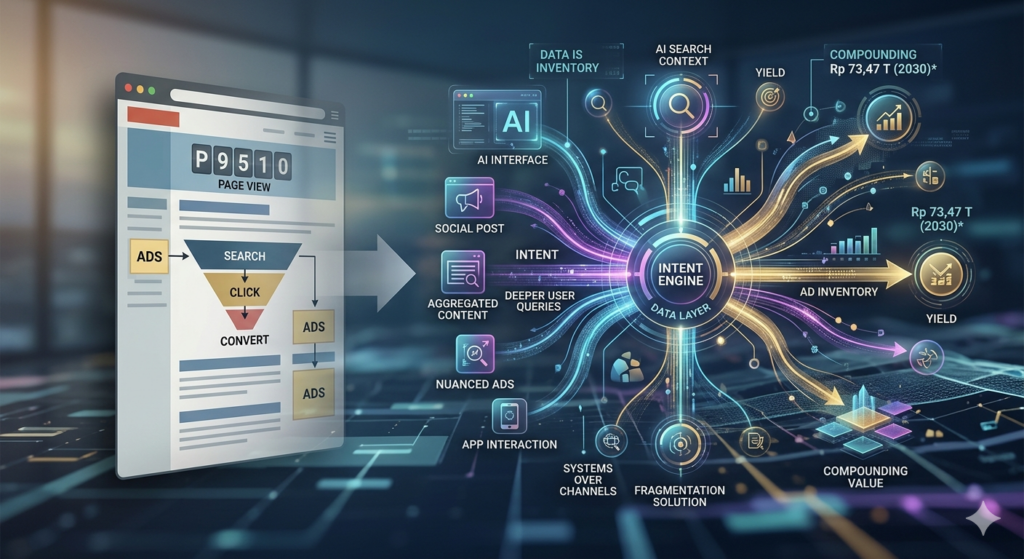
The page view built an industry.
For two decades, nearly everything in digital advertising; impressions, clicks, CPMs, yield optimization; traced back to one event: a user loading a page. Publishers built around it. Advertisers bought against it. Platforms optimized for it.
AI is not killing that model overnight. But it is quietly relocating the value that used to live inside it.
If agents start doing the browsing, and learn to route around ads, the human search-click-convert funnel is no longer the default path to purchase. That’s not a distant scenario. It’s the direction the ecosystem is already moving.
So where does monetization go from here?
Data Is the New Inventory
When a user visits a page, they leave behind more than an impression. They reveal intent, what they’re looking for, how they got there, what they did next. In the traditional model, that signal was converted into an ad impression and largely forgotten.
In an AI-driven environment, that signal becomes the asset.
The most successful data monetization strategies start with a sharp understanding of a company’s proprietary advantage, whether that’s privileged access to high-quality data, deep customer knowledge, or domain-specific infrastructure.Publishers who have spent years building audiences around specific verticals; health, finance, and automotive are sitting on exactly this kind of advantage. The question is whether they’re structured to activate it.
Local platforms like GoTo and Telkomsel are already closing the gap on global players through proprietary first-party data and exclusive inventory deals, not by having more traffic, but by understanding their audience more precisely. That’s the playbook.
Intent Is Worth More Than Impressions
Not all user interactions carry the same commercial value. A casual scroll through a news feed is a different signal from someone actively comparing financial products or researching a purchase decision. Traditional impression-based models treat these interactions as roughly equivalent. They’re not.
The complex, longer user queries in AI search are creating new ad inventory, because these queries involve deeper conversational context, Google can detect intent more finely and deliver ads for nuanced needs that weren’t easily monetized before.
This matters for publishers and brands on both sides of the equation. For publishers, it means the value of your inventory is increasingly tied to the quality of intent your audience carries, not just the volume. For brands, it means high-intent moments are worth paying significantly more to reach, even if they occur outside traditional page-based environments.
GroupM projects Indonesia’s digital ad spend will grow 13.8% and account for 75% of total ad spend by 2025, but that growth is not evenly distributed. It is concentrating in formats and channels where intent signals are stronger and more actionable.
The Fragmentation Problem Nobody Talks About
Here’s the structural issue: as the monetization surface expands, across AI interfaces, social platforms, apps, and aggregated content experiences, most businesses are not set up to capture value across all of it.
Data sits in silos. Monetization strategies are built channel by channel. There’s no unified view of how a user’s intent moves from discovery to decision.
Video ads represent 34% of digital ad spend in Indonesia, while search remains indispensable for high-intent conversions, but these channels are often managed separately, creating gaps where value falls through.
The publishers and platforms that win in this environment are the ones who stop thinking in channels and start thinking in systems. That means connecting audience data to inventory, aligning inventory to the right demand sources, and optimizing across the full user journey not just within individual touchpoints.
Where AI Actually Fits
AI is not the solution to fragmentation. It is the multiplier on top of a system that already works.
Google’s AI search revenue grew 17% to $63 billion in Q4 2025, not because AI replaced its monetization model, but because AI made the signals underneath that model richer and more actionable. The infrastructure was already there. AI made it faster and smarter.
For publishers and brands navigating this shift, the same principle applies. AI can identify high-value users, optimize pricing in real time, and adapt delivery across touchpoints. But only if the underlying data infrastructure and monetization strategy are already connected.
Without that foundation, AI optimizes fragments. With it, AI compounds value.
What This Means in Practice
Digital monetization strategy is no longer about maximizing the number of page views, it’s about maximizing the value of each intent signal, wherever it surfaces.
That requires three things most organizations haven’t fully built yet: a unified view of their audience data, inventory that can be activated across multiple environments, and demand sources aligned to the quality of intent they’re capturing, not just the volume.
Indonesia’s digital advertising market is projected to grow from Rp 55,57 trillion in 2025 to Rp 73,47 trillion by 2030 (based on Apr 2026 rates) , in an environment where the rules of visibility and value capture are changing underneath that growth.
The platforms that understand how to connect data, align strategy, and capture value across the full user journey won’t just survive that shift. They’ll define what monetization looks like on the other side of it.
ProPS helps publishers and platforms build the infrastructure to do exactly that; connecting inventory, data, and demand across the full digital ecosystem. If you’re navigating this shift, we’d like to talk.
FAQ
Q: Does this mean traditional advertising is dead?
Not at all. Traditional formats; display, search, video are still growing, especially in Indonesia where digital ad spend is projected to reach Rp 73,47 trillion by 2030. What’s changing is the logic underneath them. Impressions still matter, but they’re becoming a proxy for something more important: intent. The platforms and publishers that understand this will continue to generate strong revenue from traditional formats, they’ll just be optimizing for the right thing.
Q: What’s the difference between intent-based and impression-based monetization?
Impression-based monetization asks: how many people saw this ad? Intent-based monetization asks: how ready were those people to act? A user actively comparing loan products carries significantly more commercial value than someone passively scrolling a news feed, even if both generate one impression. As AI makes intent signals more readable and actionable, the gap in value between these two types of interaction will only widen.
Q: How does first-party data fit into this shift?
First-party data, information you collect directly from your own audience becomes critically important as the ecosystem moves away from page-based signals. It tells you not just who your users are, but what they want and when they’re ready to act. Publishers and platforms that have built strong first-party data assets are sitting on real monetization leverage. The question is whether they have the infrastructure to activate it.
Q: Is this shift relevant for smaller publishers, or just large platforms?
It’s relevant for any publisher or platform that depends on digital advertising for revenue. Smaller publishers may feel the impact of declining page-based traffic sooner and have fewer resources to adapt. But the opportunity is also proportionally significant: a small publisher with a highly specific, loyal audience and strong first-party data can outperform a larger publisher with more traffic but weaker intent signals. Niche depth beats broad volume in an intent-driven model.
Q: Where does ProPS fit in this picture?
ProPS operates at the intersection of publisher inventory, audience data, and advertiser demand, which is exactly where this shift is playing out. As a Google Certified Publishing Partner, ProPS helps publishers and platforms build the infrastructure to capture value across the full user journey, not just within individual ad placements. The goal isn’t just to optimize what already exists, it’s to make sure the right foundation is in place for monetization to work in an environment that looks very different from the one that existed five years ago.
Source:
- Xe.com — USD to IDR exchange rate (April 28, 2026)
https://www.xe.com/currencyconverter/convert/?Amount=1&From=USD&To=IDR - Mordor Intelligence — Indonesia Digital Advertising Market Size & Growth to 2031 https://www.mordorintelligence.com/industry-reports/indonesia-digital-advertising-market
- GroupM / Campaign Indonesia — Indonesia ad spend projection 2025 (13.8% growth, 75% digital) https://www.campaignindonesia.id/en/article/groupm-75-persen-total-belanja-iklan-indonesia-dikuasai-digital-di-2025/1899589
- Publisher Growth — 7 Best Native Ad Networks in Indonesia (market size $3.23B–$4.27B) https://publishergrowth.com/blog-details/7-best-native-ad-networks-in-indonesia
- McKinsey & Company — Intelligence at Scale: Data Monetization in the Age of Gen AI https://www.mckinsey.com/capabilities/business-building/our-insights/intelligence-at-scale-data-monetization-in-the-age-of-gen-ai
- Foundation Capital — Where AI Is Headed in 2026 https://foundationcapital.com/ideas/where-ai-is-headed-in-2026
- Search Engine Land — AI Mode is Google’s Next Ads Engine https://searchengineland.com/ai-mode-google-next-ads-engine-471967
- Go Tech Solution — Google Search Hits $63B: AI Mode Ads & What It Means https://go-techsolution.com/google-search-63b-ai-mode-ads-advertisers